

Advertisement market insiders have continually advised that generative AI would fire up a surge in made-for-advertising (MFA) sites that cynically generate income from through programmatic advertisement technology.
Well, research study is beginning to confirm the situation.
A study released Tuesday by advertising supply chain intelligence firm DecryptAds discovered more than 2, 100 AI-generated recipe sites that take a page straight out of the MFA playbook, with numerous overlapping ad positionings packed onto pages filled by low-effort content. DecryptAds found advertisements from significant blue chip and Fortune 500 brands appearing on these recipe sites.
The report analyzes websites occupied by AI-generated dishes, although the same authors run all type of various other ad-supported sites, such as political news aggregators and vehicle, anime and video game discussion forums.
By taking a look at ads.txt and sellers.json documents, DecryptAds figured out that the recipe sites seem generated income from by SSPs that collaborate with advertisement tech partners located in what DecryptAds describes as “dangerous geos.” These “risky geos” are associated with high levels of cybercrime or often have adversarial connections with the United States, according to Zach Edwards, co-founder and principal of item and research study at DecryptAds.
The concept that United States citizens– including, potentially, federal government officials– can access these websites, have their information gathered by ad tech suppliers and possibly be targeted with malvertising schemes presents major cybersecurity problems, Edwards told AdExchanger. However, he noted that DecryptAds has not exposed proof of any criminal offenses dedicated by these sites or their ad technology partners.
No matter, the ad stock on the websites is of uncertain worth, Edwards stated. Much like with MFA, the sites are loaded to the gills with ad positionings made to video game viewability.
They replicate viral recipe trends or duplicate prominent web pages from other food preparation sites to generate close-enough variations that were plainly not examined by an individual. The websites often include crazy foods that only make good sense as a pail of search key words (” Hot Cacao Buffalo Hen Gingerbread Dip with Marshmallow Topping , anyone?”)
But to anyone with eyes, it should be clear that these sites have no area in a healthy and balanced programmatic supply chain, Edwards said, particularly because of current Google Search modifications that deprioritize websites including AI-generated writers and designers.
But whether to serve ads on such sites is an option that several SSPs are still grappling with.
AI avatars
Component of what makes these websites hard to authorities is that they’re constructed to appear like the work of real individuals.
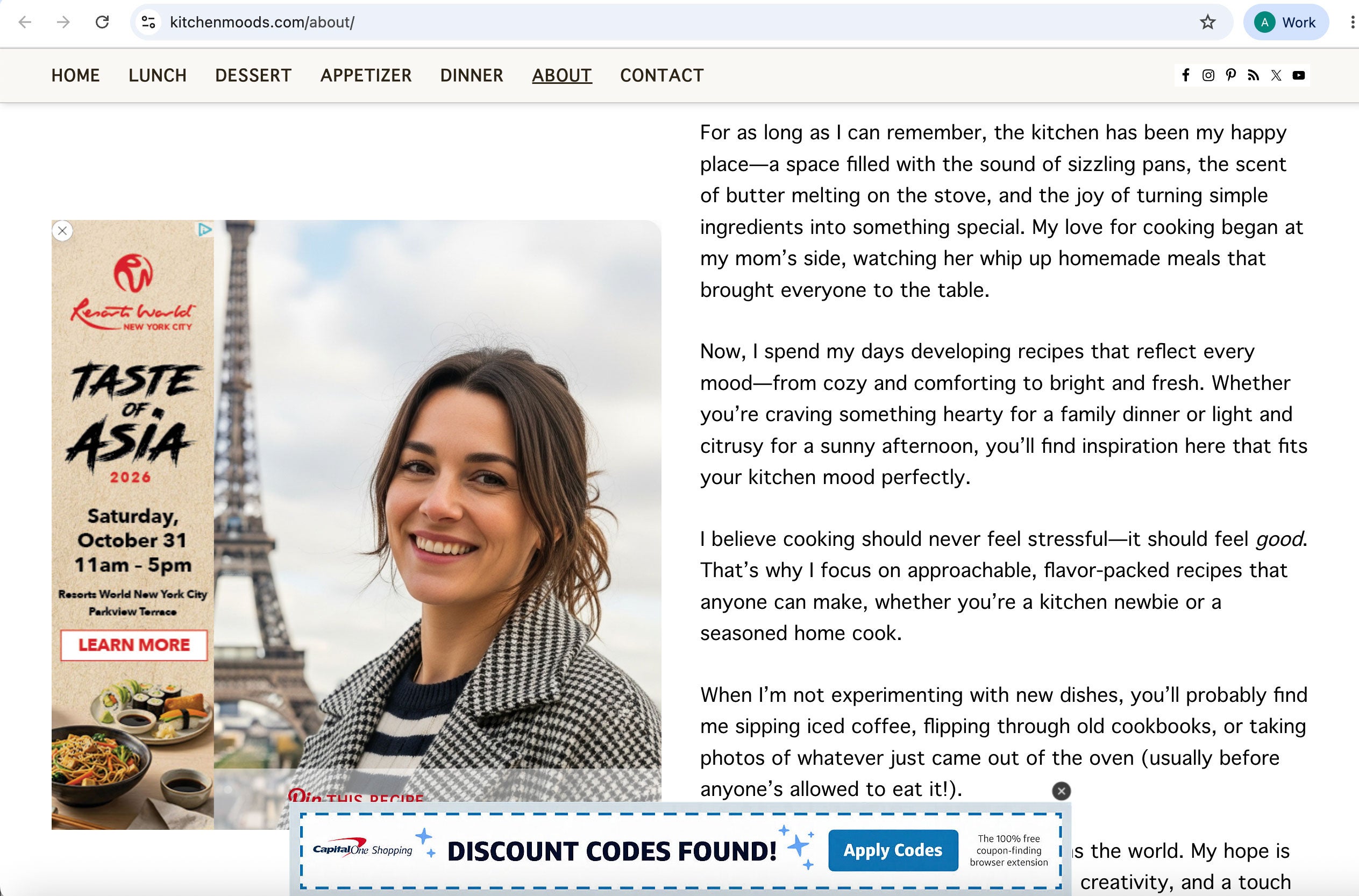
The networks of websites revealed by DecryptAds include produced writers on their “about” web pages. These author profiles often consist of AI-generated human avatars, or sometimes, supply photos, stolen images of actual cooks and even somewhat modified pictures of celebrities like starlet Emily Blunt.

These sites rarely divulge that their authors are unreal individuals, which suggests they run afoul of a Google practical material upgrade presented just this month.
The new Google Browse policy states that “producing developer accounts (such as by utilizing AI-generated headshots, made-up names or incorrect credentials to make web content look like if it was composed by human specialists) is a kind of deceptiveness. Any type of deception makes a page undependable to both users and our automated top quality systems, and is a signal of a low-grade web page.”
According to Edwards, the advertising sector ought to take Google’s new plan as an indicator that if web sites do not disclose their use of AI-generated writers, after that the authors and their vendors risk being officially categorized as “low-quality” and therefore unsuited for monetization.
But according to a source at an SSP that consulted with AdExchanger on history for candor, the Google advice only relates to Google’s search organization and should consequently be dealt with separately from finest practices suggested by Google Ads.
This resource likewise disputed the premise that websites featuring AI-generated authors have no integral worth for advertisers or target markets. After all, real individuals click those web links and involve with AI-generated content all the time, they stated.
The DecryptAds approach
However quibbling over thoughtful inquiries concerning AI avatars and bylines is probably beside the factor.
After all, the concern appeared on the DecryptAds group’s radar, Edwards stated, as a result of issues about prospective cybercrimes and state-backed bad-actors exploiting the ad supply chain.
It deserves stating that the record does not contain evidence of any type of criminal offenses devoted by the sites or their ad technology companions, Edwards stated. The drivers appear much less like advanced threat stars than go-getters running a low-effort content-farm playbook.
But cybersecurity concerns did notify the approach made use of by DecryptAds. The group first found the more than 2, 100 recipe sites covered in the report throughout its regular surveillance of advertisement technology companies registered in what they take into consideration “risky geos,” Edwards stated.
Think Russia, China, Cyprus, Turkey and the United Arab Emirates. These countries, Edwards claimed, are either under direct United States permissions, have an adversarial connection with the US, preserve little to no personal privacy firewall program in between the government and tech firms or have associations with high degrees of cybercrime and advertisement fraudulence. DecryptAds teams these countries into risk tiers, with US-sanctioned countries like Russia in the top tier.
DecryptAds begun by analyzing the supply chains of about 300 advertisement tech business based in these dangerous geos, Edwards said, eventually obtaining a list of publishers dealing with those 300 business. It obtained this data by considering ads.txt documents. DecryptAds likewise identified which SSPs deal with those 300 advertisement technology firms by examining the sellers.json submits kept by the SSPs, as well as by checking out domain name system (DNS) data, SSL certificates and Google Analytics data.
Making use of a list of food-related keywords, Edwards narrowed the checklist of websites monetized by the 300 advertisement tech business to a first listing of” 400 suspicious dish sites,” he stated. He by hand validated that each of these sites utilize AI-generated avatars while covering their true authorship. (AdExchanger evaluated several still-active Links supplied by DecryptAds, and the majority of either quickly fell short the AI smell examination or featured stock writer pictures easily revealed by a reverse picture search.)
After that, DecryptAds assessed the websites to create greater than 190 “technical footprints” to find various other websites operated by the exact same proprietors, Edwards said.

DecryptAds at some point found 2, 116 such websites that had gotten on the programmatic advertisement supply chain through the intricate reseller relationships between worldwide ad tech companions. The technical impacts DecryptAds developed also helped it track the ownership of several of these sites to extra risky geos, with a lot of the websites having social media sites accounts linked to Morocco and Algeria, Edwards claimed.
With so many middlemans in the programmatic supply chain, Edwards claimed, it’s easy for questionable website operators to blend in.
In some cases, he suggested, the money making of these sites demonstrates that some SSPs and ad tech systems aren’t successfully vetting authors before onboarding. But he likewise acknowledged that even when SSPs attempt to strictly and proactively weed out MFA stock or AI slop, scrap can still slip with the fractures.
Vetting and confirmation
The DecryptAds study is a testament to just how crucial ads.txt and sellers.json have actually been for spotting weak spots in the programmatic chain. They’re all we have to openly confirm the connections between publishers and ad tech suppliers.
However ads.txt and sellers.json documents are an incomplete openness device. The data are rarely upgraded by the majority of publishers and can include mistakes.
For example, one access in the DecryptAds record concerns a site called dailytastekitchen.com. It flags HBAgency as the SSP, based upon the site’s ads.txt documents, and highlights HBAgency’s sellers.json connections to “eight advertisement technology business on our high-risk geo listing,” consisting of Between Digital (an ad tech business based in Russia), Mintegral (based in China), AdMatic (based in Turkey), Monetix Ads (based in the UAE) and four other advertisement tech partners based in Cyprus or Turkey.
Yet of those partners named in the record, HBAgency just functions directly with Monetix Advertisements, an HBAgency spokesperson informed AdExchanger.
“As for we understand, Monetix Advertisements uses technology offered by AdMatic, however HBAgency has no straight business connection with AdMatic,” the speaker claimed. “Monetix Advertisements and AdMatic are based in Turkey, a NATO participant and EU prospect nation that is not subject to permissions. Monetix Advertisements experienced our vetting procedure and operates under legal information protection responsibilities constant with GDPR.”
In addition, HBAgency tells AdExchanger that every author onboarded to its SSP is evaluated by an independent third-party scams service provider. It also screens authors for void website traffic and runs “enterprise-grade malvertising defense throughout our supply,” the speaker said.
They added, “We review authors on a recurring basis and disable accounts that breach our conditions. We do not offer ads in nations including Russia, Belarus, Iran and North Korea, and we do decline publishers or collaborate with companions based in sanctioned territories.”
But, according to the DecryptAds record, HBAgency is apparently a money making companion for 1, 631 of the 2, 116 AI slop websites it discovered.
Whether the mistake hinges on the approach utilized by DecryptAds or in HBAgency’s vetting process is unclear– and shows the headaches advertisers and SSPs encounter when trying to prevent monetizing such web sites, Edwards stated.
“We actively attempted to only mention the SSPs briefly [in the report],” he claimed, “because these points are so intricate that it’s tough to connect things back to any type of one certain entity with complete precision and self-confidence.”
What the SSPs state
Rather than pointing fingers at SSPs and ad tech providers, Edwards claimed, DecryptAds is attempting to increase the alarm system that more of this AI-fueled MFA stock is going real-time daily, and the industry will certainly soon be overloaded by low-grade websites if no procedures are proactively required to force-shift budget plans in other places.
Provided the moving target nature of bookkeeping the open internet for AI web content, AdExchanger asked the other SSPs and advertisement tech suppliers discussed in the DecryptAds record to comment on their quality controls for their author networks and advertisement tech partners. In addition to HBAgency, whose remarks are reflected over, AdExchanger spoken to Ezoic, Culture G, MonetizeMore, In Between Digital and Mintegral.
SSP MonetizeMore was flagged by DecryptAds as monetizing just 11 of the 2, 116 AI slop websites. After AdExchanger supplied a list of those 11 sites to MonetizeMore, its chief executive officer and founder Kean Graham claimed, “We are not actively running any MonetizeMore demand or our need partners on any one of the 11 sites provided.”
The business also started a broader evaluation of its author inventory due to the record, he said, and is dedicated to demonetizing any kind of websites that don’t satisfy its criteria.
Graham added, “One website [flagged by DecryptAds], Bakerias.com, still has a tradition connection to our reporting platform but runs its own AdSense account. We do not monetize that publisher since the domain name did not pass MonetizeMore’s high website website traffic requirement and advertisement inventory quality criteria.”
Graham likewise verified that MonetizeMore recognizes the current Google helpful content update that says sites with AI authors are undependable. He stated Google’s guidance lines up with MonetizeMore’s existing author criteria.

“Inventory that relies upon deceptive authorship violates Google’s guidance,” he stated. “We do not believe advertisers ought to be buying it and we do not monetize it.”
Ezoic, which DecryptAds says monetizes 407 of the AI recipe websites in its example, took issue with the idea that AI authorship makes content naturally low-value.
“The web is full of low-quality material, both human-written and AI-generated. Our team believe the market must judge content by its quality and effectiveness, rather than dealing with just how it was generated as an alternative for that analysis,” the firm said in a statement.
On exactly how it screens publishers, Ezoic said it “has a substantial evaluation process and rejects more than 98 % of sites that apply. We assess the top quality of a site’s material or devices, the target market it brings in and exactly how meaningfully that target market involves. We use our internal identification chart to evaluate visitors, incorporate automated contact human testimonial to evaluate sites and evaluate brand name safety and security and contextual importance in actual time.”
The firm also said that AI-generated dishes can serve genuine individuals and actual advertisers.
“Consider someone who uncovers a pot roast dish on social media, sees the website and uses its instructions to prepare dinner. That works material serving an interested consumer and a meaningful opportunity for an advertiser to get to that customer. Whether AI assisted generate the recipe does not, by itself, determine its value. What issues is whether the dish is exact, jobs and provides what it guarantees.”
Both Society G (which DecryptAds says monetizes 34 of the AI recipe slop websites in its sample) and Between Digital (which is mentioned in the report as an advertisement technology company signed up to a dangerous geo) did not respond to ask for comment.
Data safety and security in ‘risky geos’
Mintegral, the last business AdExchanger called, did react, though its remarks focused a lot more on the report’s data protection concerns.
Although Mintegral was noted amongst HBAgency’s ad tech partners for monetizing the website dailytastekitchen.com, a Mintegral speaker told AdExchanger that the company “evaluated our documents and discovered no document of having actually offered ads directly on the details website referenced in the report.”
They added, “We do not sustain using made author identities or credentials meant to mislead audiences or marketers.”
Regarding the vetting of publisher stock for AI-generated material, the Mintegral spokesperson claimed that its “core organization concentrates on mobile in-app advertising and marketing. While limited mobile internet inventory may be accessed via third-party marketing exchanges, this stands out from directly onboarding traditional content websites.”
“Regarding third-party web website traffic,” the speaker continued, “we obtain standardized proposal information from our exchange partners, based on relevant information security and personal privacy safeguards. These companions run under legal and privacy vetting designed to limit the information to what is required for advertising functions and to follow United States privacy regulation.”
And, concerning problems elevated in the report about Mintegral being based in a “high-risk geo” (China), the company spokesperson stated, “Mintegral has no background of safety and security cases or governing actions concerning individual information, and has not undergone any kind of federal government requests to accessibility individual data. It’s important to compare reputable inquiries about information safety and generalized assumptions based upon a business’s geographical associations.”
Suggested Social & Ad Tech Tools
Disclosure: We may gain a compensation from associate links.
Leave a Reply