
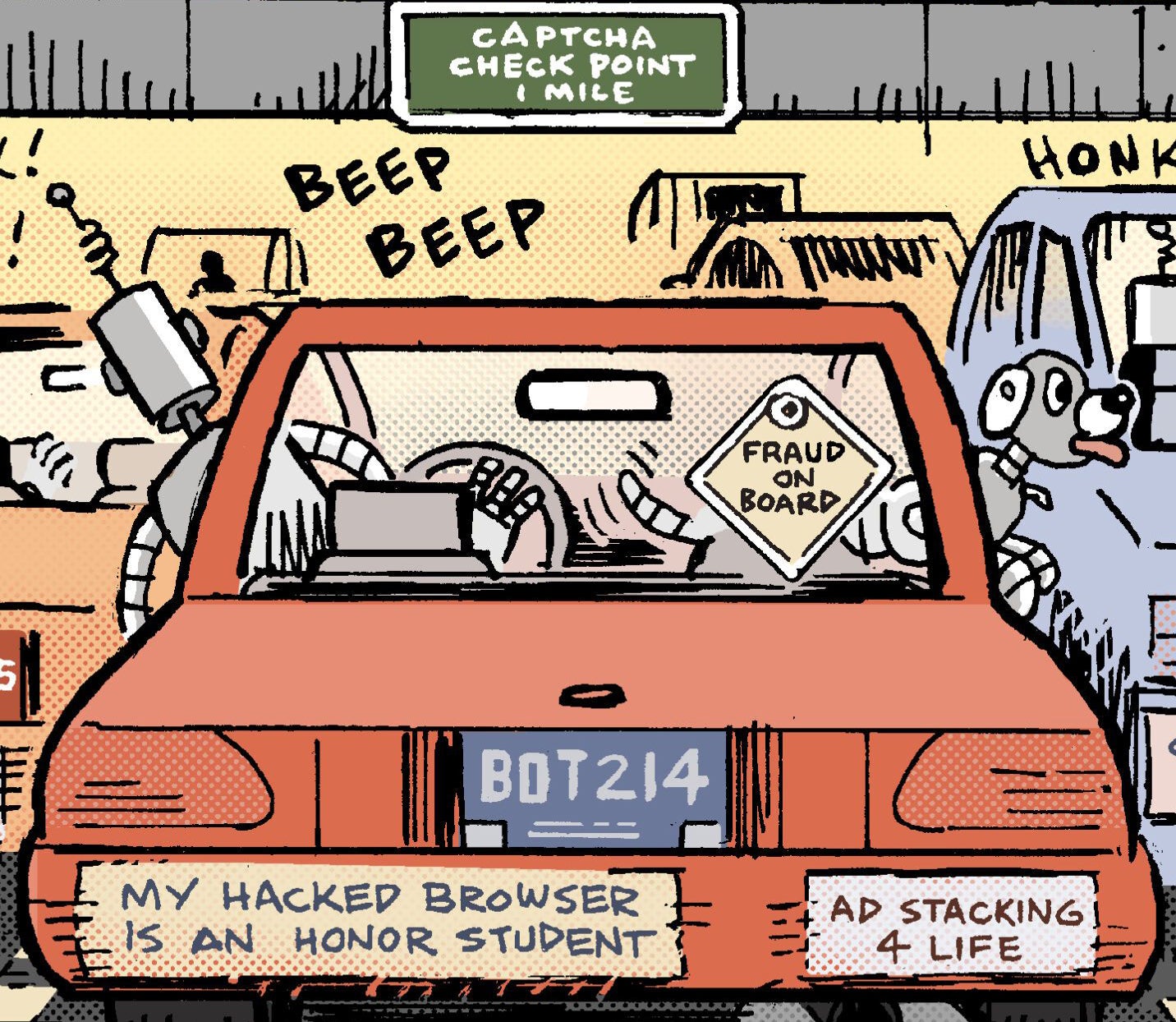
On the bot-riddled open internet, it can be a battle to prevent advertisements from being offered to invalid website traffic (IVT).
To remove IVT and avoid ad offering to crawlers, the ad sector focuses on data consisted of in bid requests, such as user representative details and IP addresses. Yet, offered the billions of bid requests transacted by programmatic platforms every hour, unethical website traffic inevitably slides with.
Provided the vulnerability of programmatic supply, ad confirmation carrier human being has lately begun complementing its proposal demand evaluation by evaluating the time between when a robot clicks an advertisement and when the landing web page tons, stated Geoff Stupay, SVP of product at person.
Examining these page-level signals alongside bid demand information, he claimed, implies human being can identify robots at different factors of the electronic journey than it might before, he stated.
On Tuesday, person presented a brand-new offering, called Web page Knowledge, that prolongs its IVT security to likewise consist of marketers’ touchdown pages, Stupay claimed. This technique efficiently catches IVT at “the closest point to a conversion or to a brand engagement event,” he claimed.
The rollout also signifies a notable modification in person’s technique: Whereas the verification supplier has actually long partnered straight with programmatic platforms like The Profession Workdesk and large system publishers like LinkedIn, its new offering is for private marketers, Stupay said.
Keeping negative data out
Web page Intelligence, like many various other IVT discovery approaches, is a post-bid dimension. After all, a crawler should have been offered an ad in order to have clicked it and wound up on a touchdown page.
So, the item isn’t necessarily aimed at avoiding a crawler from seeing an advertisement in all. Rather, it helps in post-campaign reconciliation, when brand names and their companions account for IVT perceptions that need to not be spent for by the marketer.
This technique of IVT detection is likewise a protect against conversion information from crawlers polluting a brand’s first-party audience information, Stupay said. Having more granular data on the traffic that shows up on their landing web pages need to aid advertisers make smarter choices and prevent chasing malfunctioning data, he said.
For example, if Web page Intelligence locates that a current type entry on a landing page was tied to a robot perception, after that HUMAN can immediately discard that data prior to it makes its way into the brand name’s CRM or CDP, Stupay claimed.
If certain media sellers produce conversions on clicks or form sign-ups, yet those turn out to be substitute robots, brands can potentially cut off financial investment in that stock.
Click-source agnostic
Likewise, due to the fact that Page Intelligence examines the impact after it gets here on the landing web page, the product offers advertisers with click-based data they don’t obtain from walled gardens, Stupay added.
As an example, if an advertiser is running a verification pixel in its ad creative with most open web advertising platforms, they would be given with some form of upstream signal regarding whether the advertisement was most likely served to a crawler, he stated. Yet, if the click comes from a walled yard like Facebook, he claimed, “they’re mosting likely to need to review what’s arrived when it’s shown up.”
Because person is taking a look at post-click data, “no matter where the website traffic is coming from,” Stupay said. So, whether the website check out originated from an internet screen advertisement, a mobile in-app ad or a CTV advertisement impact, the item works the exact same.
To examine the web traffic after it’s clicked an advertisement, HUMAN primarily counts on the very same signals it checks out to catch IVT before it clicks an ad, such as user agent and IP address, Stupay claimed. For example, the system would be seeking information mismatches in the user representative or indicators that the impact is linked to a brainless web internet browser or a spoofed device. Person obtains accessibility to these signals using a solitary line of JavaScript code deployed on the touchdown page.
Who makes the decision?
Yet past considering usual IVT-detection signals, Stupay said, Page Intelligence also has its “unique sauce” that integrates thousands of various inputs and historical information from HUMAN’s other bot-detection initiatives.
Page Knowledge’s underlying tech is based on HUMAN’s MRC- and TAG-accredited IVT detection technology, Stupay said, and marketers can expect the exact same degree of IVT security that person’s platform companions have actually lengthy taken pleasure in. Although, he added, Web page Knowledge itself is not currently MRC- or TAG-certified.
Speaking of the MRC, the qualification group lately published a paper related to pre-bid robot detection in reaction to an Adalytics report from previously this year that claimed pre-bid IVT purification given by the major verification suppliers did not accurately stop advertisements from being offered to crawlers. The MRC declaration says that, while third-party confirmation companies can flag IVT utilizing pre-bid purification methods, “The decision to offer a proposal request or serve an ad entirely rests with DSPs and SSPs.”
In other words, bot discovery carriers can determine crawlers, yet it’s up to their system companions to take that signal and determine not to serve the advertisement.
Page Intelligence is not a pre-bid product, to ensure that susceptability doesn’t apply, Stupay claimed. Page Intelligence also puts the information needed to make a decision regarding an ad impact directly into the advertiser’s hands, rather than providing it to the platform, he claimed.
Now advertisers can make their own choices, Stupay included.
“Maybe that means you request for some sort of settlement. Possibly that indicates you just do not deal with that specific stream or target advertisements because details means,” he said. “Those are all choices the client can make.”
Suggested AI Marketing Devices
Disclosure: We might earn a compensation from affiliate web links.
Original coverage: www.adexchanger.com
Leave a Reply