
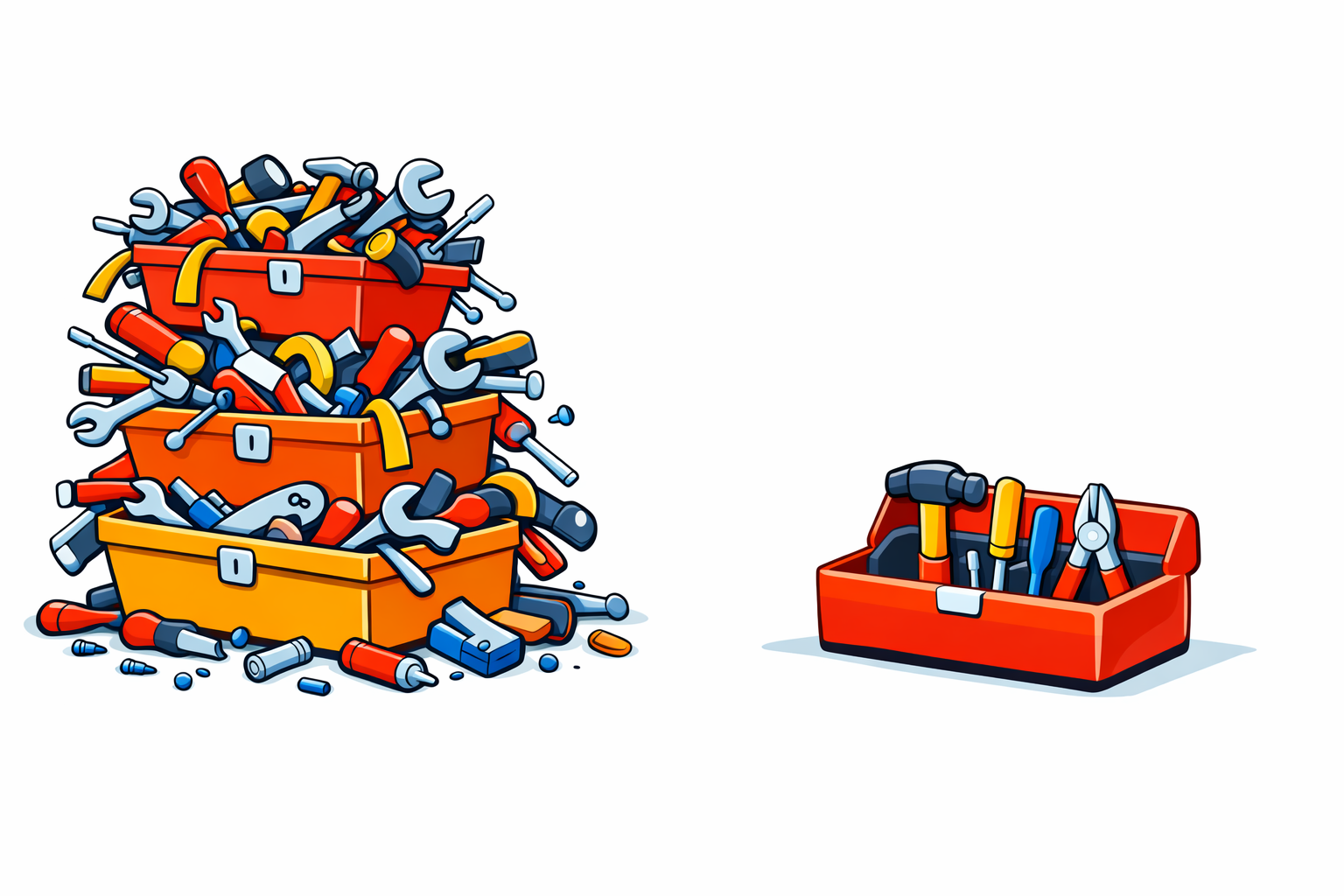
Every week, there’s a brand-new AI-powered marketing tool promising to reinvent your workflow. It’s alluring to attempt them all. However right here’s what’s in fact taking place: marketing heaps are more chaotic than ever, teams are bewildered, and the majority of devices are sitting extra while the expenses keep coming.
The actual trouble isn’t that you do not have enough devices. It’s that you have way too many, and a lot of them aren’t drawing their weight.
Advertising modern technology financial obligation isn’t practically unused memberships. It’s the built up cost of complexity, combination failings, and group irritation that develops over time.
Consider it: Every new device you add creates even more connections to handle, extra logins to bear in mind, more data staying in different places, and extra choices about which system to make use of for what. Each enhancement makes the whole system much more breakable.
AI devices are accelerating this trouble. They’re very easy to add and promise prompt efficiency gains. However they’re more difficult to incorporate with your existing systems, and a lot of teams are adding them faster than they can actually embrace them.
The result Your stack gets larger, your group gets slower, and you’re spending for ability you’re not making use of.
Do you have marketing modern technology financial obligation?
Use this checklist to analyze your situation truthfully. If you examine 3 or even more boxes, it’s time for a deep audit.
Use and adoption warnings
- Your team proactively prevents utilizing devices you’re spending for– they have actually found workarounds or just ignore particular platforms.
- New staff member take 2 + weeks to learn your tools (and that’s just the tools, not the actual advertising and marketing approach).
- You can’t keep in mind the last time somebody logged right into at least 3 of your paid systems.
- Your group asks “Which tool should I utilize for this?” numerous times a week because you have overlapping performance.
- You invest more time training people on just how to use platforms than on advertising and marketing method.
Assimilation and data red flags
- Your data lives in 5 + various areas, and they do not concur with each various other. You get various numbers relying on which dashboard you inspect.
- Drawing a report calls for exporting from multiple tools and manually incorporating the data.
- You have actually claimed, “We require to incorporate X with Y” for more than six months, and it still hasn’t taken place.
- You’re manually going into the same details right into numerous systems as component of your day-to-day process.
- APIs break consistently, and no person notifications for days.
Dig deeper: What, precisely, is a ‘full- stack marketer?’
Cost and value red flags
- You’re not sure what you’re in fact spending for– registrations are spread throughout credit cards and divisions.
- You justified a device purchase by claiming “we’ll turn into it” more than 12 months earlier, and you’re still not making use of most features.
- You’re paying for user seats that aren’t being used (team members that left or never ever obtained onboarded)
- When asked what ROI a specific tool offers, you can not link it to real business end results.
- You’ve kept a device only since “we already paid for the yearly membership.”
Strategic and organizational warnings
- Various staff member utilize various devices for the same feature with no standardization.
- You’ve bought devices reactively to fix immediate troubles without total technique.
- Leadership can not conveniently see advertising efficiency– they need you to produce a custom deck to convert what’s taking place.
- You have shadow IT devices that staff member bought themselves or utilize totally free make up.
- Someone leaving the firm develops a crisis around who has access to what.
Function and functionality red flags
- You’re using less than 30 % of the features you’re spending for.
- Your business platform is excessive for your actual needs.
- You have 3 + tools that do basically the very same point.
- Customized development or workarounds are needed to make your devices do fundamental jobs.
- You have actually acquired attachments or assimilations simply to make tools speak to each various other.
Dig deeper: The information top quality paradigm change has arrived
Scoring
0- 2: You’re in good shape. Your stack is fairly lean and functional.
3 – 5: You have some financial debt accumulating. Time for a concentrated audit on issue areas.
6 – 10: Modest financial debt. You’re most likely losing budget plan and team efficiency. Schedule a detailed pile review.
11 – 15: Significant financial obligation. This is actively harming your marketing effectiveness and group morale. Significant loan consolidation required.
16 +: Essential financial obligation. Your stack is doing extra injury than excellent. Consider starting fresh with a clean-sheet strategy.
(For even more concerning martech financial debt, see this introduction )
AI is making this problem worse, quicker. New AI-powered devices launch each week, each assuring to make your marketing more effective. The temptation to include them is strong.
Yet here’s the mystery: devices that must save time are taking more time to manage. The guarantee of automation is creating extra complexity. And budget stress makes this waste more unpleasant than ever.
If you don’t resolve your MarTech financial obligation currently, it will just obtain heavier.
Exactly how to enhance your pile
Below’s how to clean up your advertising and marketing innovation financial debt and construct something extra sustainable.
Step 1: Take supply
Listing every tool you’re presently using. Include the month-to-month or yearly expense and the primary customers. Be sincere concerning last login days. Don’t fail to remember the “darkness IT,” the devices employee are utilizing that aren’t formally accepted or tracked.
This action alone will certainly shock you. Many advertising and marketing leaders do not have a complete image of what they’re really paying for.
Action 2: Examine each device
For each system, answer 3 inquiries:
- What specific problem does this resolve? Not what it can do or what you acquired it to do. What issue is it really fixing right now?
- Who utilizes it on a regular basis and how often? If the answer is “no one” or “I’m not exactly sure,” you have your solution.
- What would actually break if we terminated it tomorrow? This is the honesty examination. If absolutely nothing would certainly damage, you do not require it.
Step 3: Determine quick victories
Look for tools you can terminate this month with no effect. These are your quick wins– instant spending plan savings and lowered intricacy.
Also, try to find duplicate capability. Do you have 3 tools that all send out e-mails? 2 analytics platforms that reveal similar information? Numerous social networks schedulers? Select the one your team in fact makes use of and cut the remainder.
Dig deeper: Your AI is not assisting if it makes me do the job
Action 4: Address integration failings
Where are you manually relocating data between systems? Which tools aren’t speaking with each other? What’s the real cost of these disconnections in terms of time and accuracy?
Occasionally the best action is to eliminate one side of a failed combination instead of attempting to fix it. If 2 tools won’t collaborate and you’re investing hours by hand linking them, reduced one.
Step 5: Consolidate strategically
Try to find platforms that can replace two or three tools you’re presently utilizing. Focus on devices your group really suches as collaborating with– adoption issues greater than attribute checklists.
When you’re evaluating replacements, convenience of use defeats function count. A tool with 80 % of the features that your group will actually use is better than a tool with 100 % of the attributes that rests unused.
Step 6: Produce a sustainable purchasing process
The objective isn’t just to tidy up your existing pile. It’s to quit developing brand-new financial obligation.
Prior to you purchase any type of brand-new device:
- Record the specific trouble you’re attempting to fix
- Inspect if an existing device can resolve it
- Pilot with a small team prior to turning out company-wide
- Set a 90 -day check-in to examine if it’s actually functioning
Build in routine stack audits– quarterly or at a minimum two times a year. Designate someone to track tool usage and ROI.
AI tools deserve special interest because they’re the most recent source of stack bloat and can accumulate rapidly.
Prior to adding a new AI-powered device, ask yourself the following:
- Can this change something I’m already doing, or does it include in the stack? If it’s including, examine the spaces it can load and whether various other tools in your toolbox could manage this work.
- Can I check this with a totally free variation first? Benefit from the free of charge tests offered by the majority of AI tools. Do not commit to a yearly contract up until you know it works for your team.
- Do my existing tools already have AI attributes? Lots of platforms you’re already paying for have added AI abilities. Examine prior to you get something new.
The self-control to say no to new AI tools may offer you a competitive advantage now. While your rivals are sinking in choices, you can be much more dexterous with less, better-integrated tools.
Dig deeper: More powerful targeting begins with straightened identities and ICPs
The reward of a lean pile
When you decrease your MarTech debt, your team moves much faster because there are less barriers in their way. Data comes to be even more reliable and actionable because it’s not scattered throughout a lots systems. Your spending plan goes to devices that actually supply ROI, not ones that sit extra. New team members can onboard rapidly since they do not require to learn 15 systems. And you can actually see what’s functioning due to the fact that your coverage isn’t fragmented.
A lean stack isn’t around having less capacity. It’s about having the best capability that your team will really make use of.
Don’t attempt to deal with every little thing at once. Start with the obvious waste– the tools nobody makes use of, the replicate capability, the fallen short integrations that are costing you hours weekly.
The bottom line
More tools do not make you much more reliable. The right tools, used well, make you extra effective.
In an age of AI and unlimited options, the discipline to enhance and say no is your competitive advantage. While various other groups are sinking in intricacy, you can develop something lean, focused, and in fact practical.
Your advertising pile should make your team’s work easier, not harder. If it’s not doing that, it’s time to make some cuts.
Fuel up with complimentary marketing understandings.
Adding writers are welcomed to produce content for MarTech and are selected for their proficiency and contribution to the martech neighborhood. Our factors function under the oversight of the content staff and contributions are checked for high quality and importance to our viewers. MarTech is had by Semrush Contributor was not asked to make any type of direct or indirect points out of Semrush The viewpoints they reveal are their very own.
Advised AI Advertising Equipment
Disclosure: We may earn a compensation from associate web links.
Initial insurance coverage: martech.org
Leave a Reply