
Happy New Year!
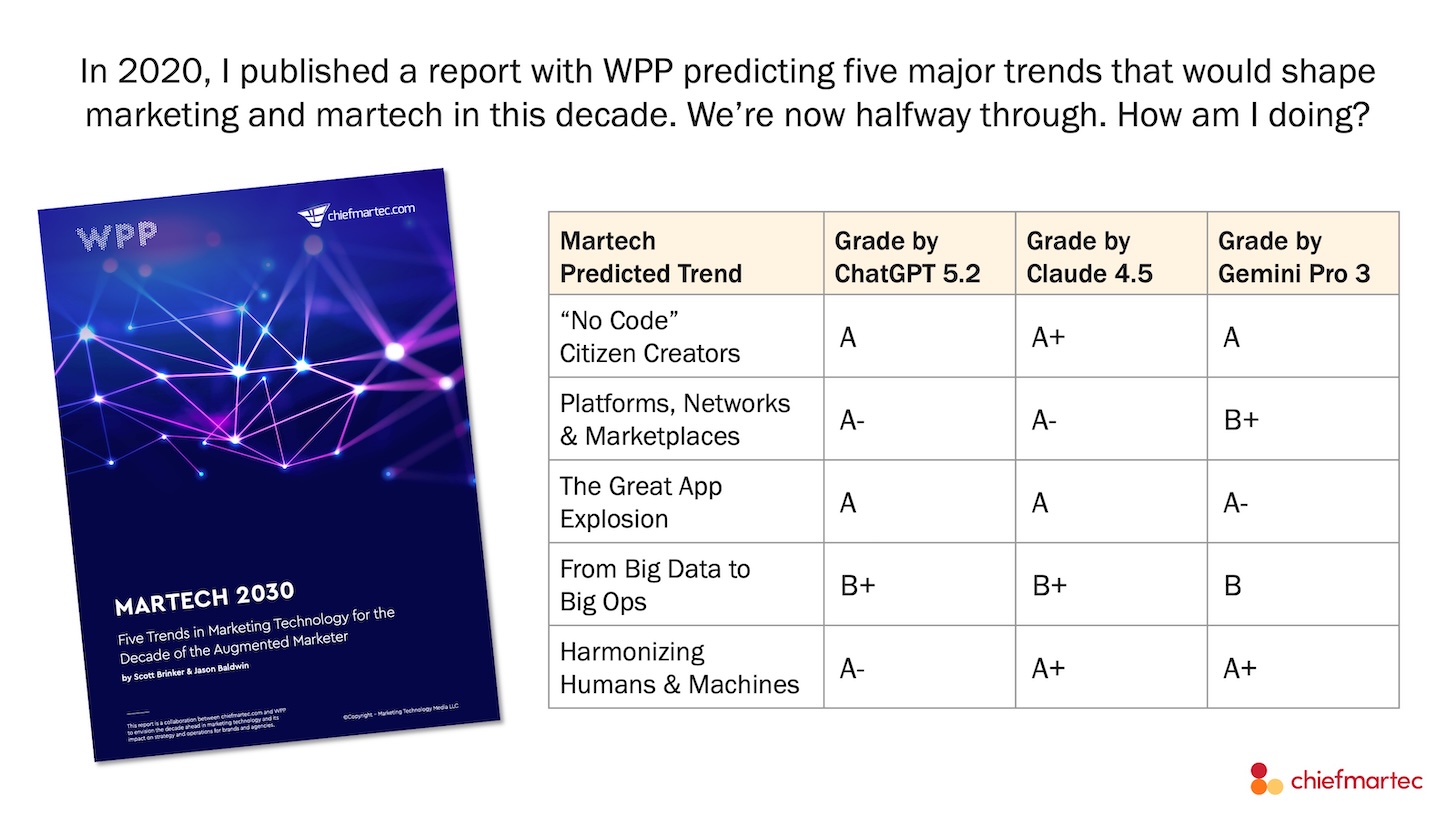
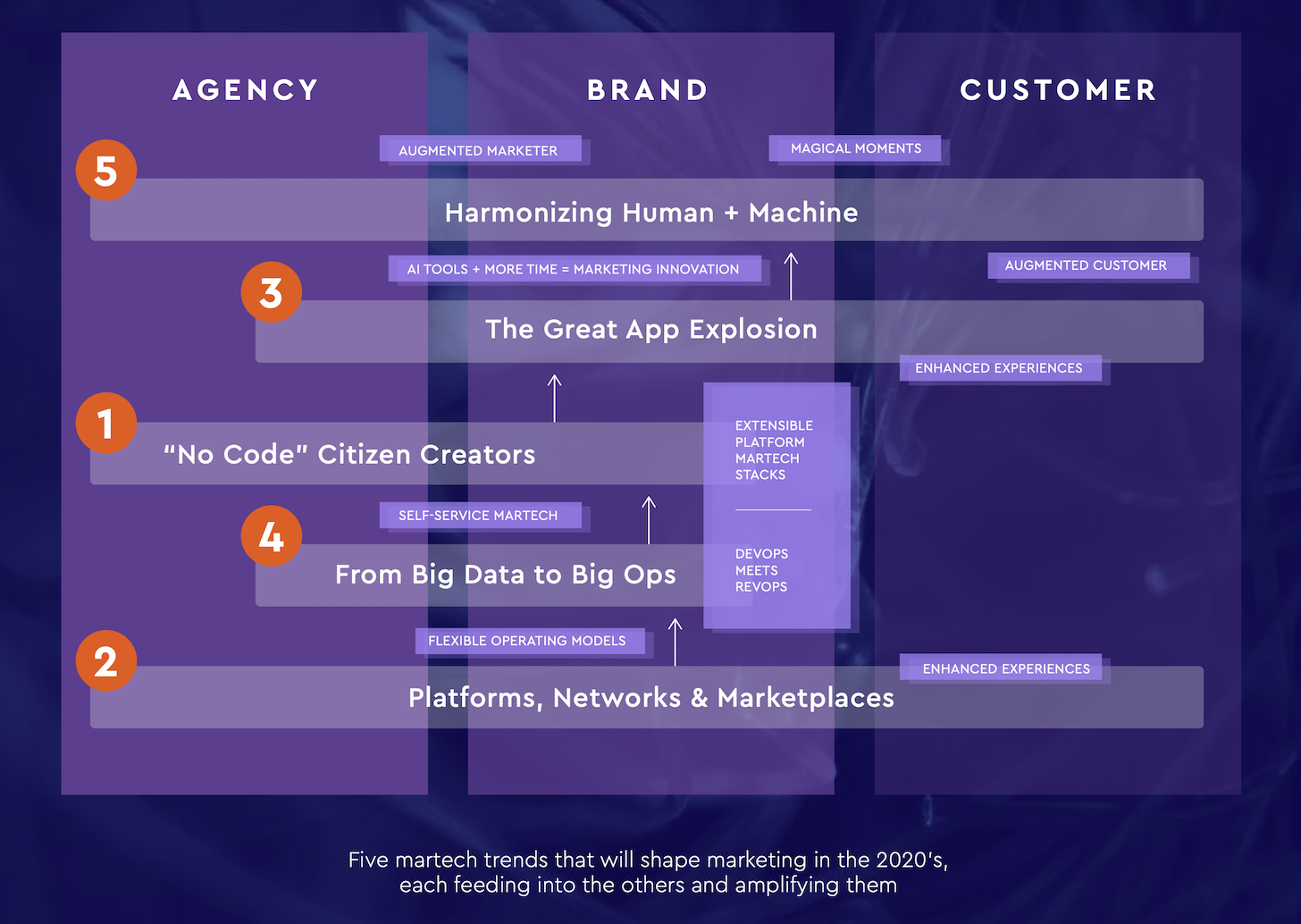
Five years back, Jason Baldwin and I published Martech 2030 (ungated PDF), a record predicting 5 major trends that would certainly shape marketing and martech through what we christened The Decade of the Enhanced Marketer
We’re currently at halftime at the beginning of 2026
Exactly how are those predictions standing up? I asked ChatGPT, Claude, and Gemini to quality them. Their analyses were pretty positive– particularly for our vision of “integrating humans & equipments.” (It deserves a chuckle that Claude and Gemini gave us A+’s on that one. Really unified.)
But you should be the real court. Exactly how do these associate your lived fact?
Fad # 1: “No Code” Citizen Creators
Also in the previous years, I was currently favorable regarding “no code” systems encouraging marketing professionals to self-service application of their digital ideas. Airtable, Webflow, Zapier were my go-to instances for data sources, websites, and operations automations specifically. Gartner called these individuals citizen makers. I have actually called them “advertising and marketing manufacturers,” contractors in the go-to-market world. And I anticipated that we ‘d see a whole lot even more of them– with a lot more power at their fingertips.
In all modesty, we toenailed this one. But largely as a result of a growth that we didn’t see coming: the generative AI explosion that started in late 2023
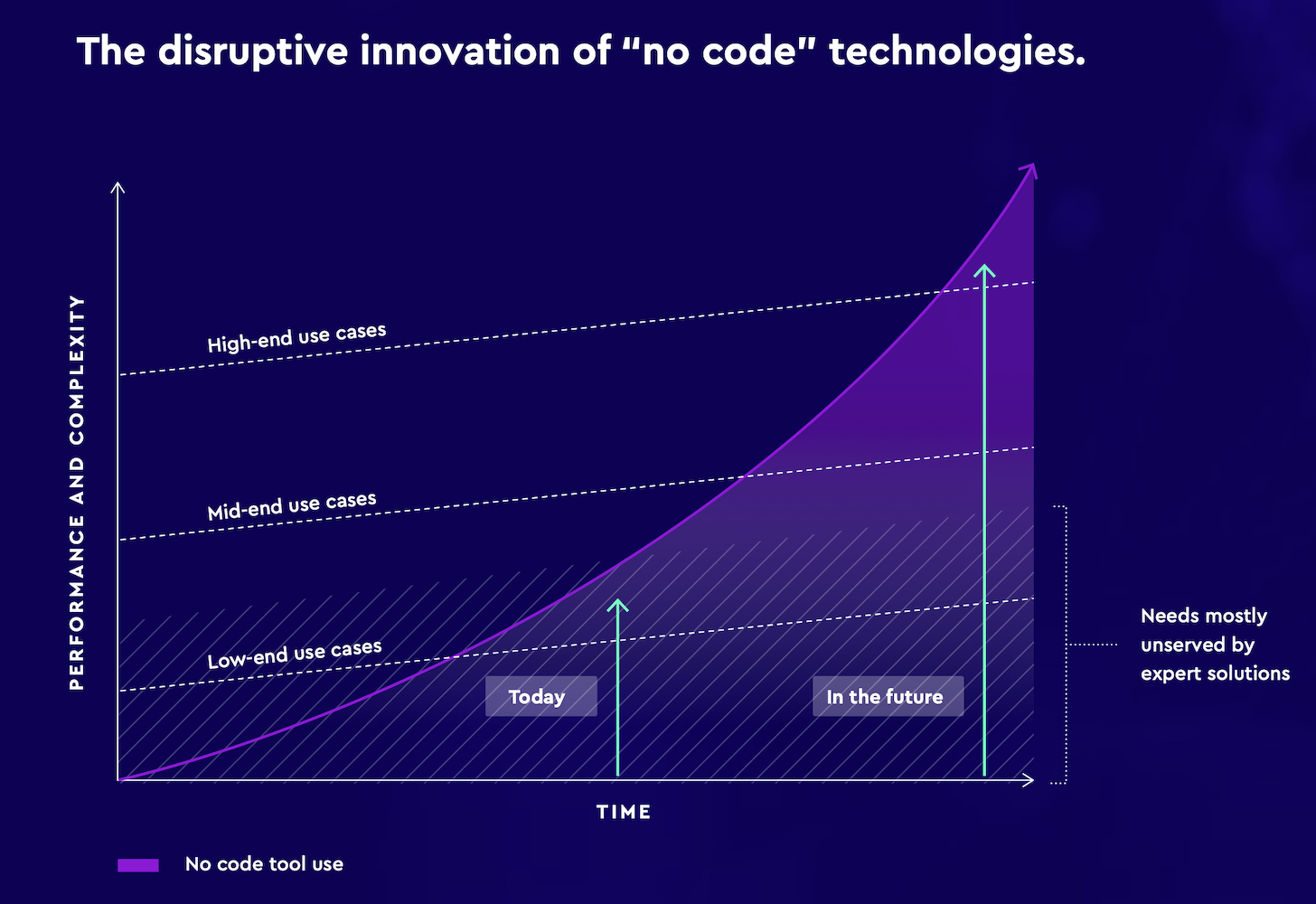
No code used to be mostly drag-and-drop. With LLMs, all of a sudden you might simply define what you wanted, and the AI would certainly produce it. At first, it was mainly for producing text and six-fingered photos ( paging Inigo Montoya Yet over the previous two years, you could chat your way into building applications, representatives, video clips, infographics, workflows, campaigns, information evaluations, PowerPoint decks, etc. It’s still a jagged frontier, yet the result for a lot of these is getting quite great.
As Andrej Karpathy stated, “The most popular new programs language is English.”
The ambiance coding phenomenon of 2025– a term created by Karpathy– pressed this into hyperdrive. Screw, Adorable, Replit, and Vercel made it hugely easy for non-engineers to create applications and agents. Given, this functioned best for reasonably basic usage cases. However those were specifically the type of underserved opportunities that Clay Christensen had actually observed as the foundation of turbulent technology. See my message on the Lemkin Range of Vibe Coding for a much deeper dive on this.
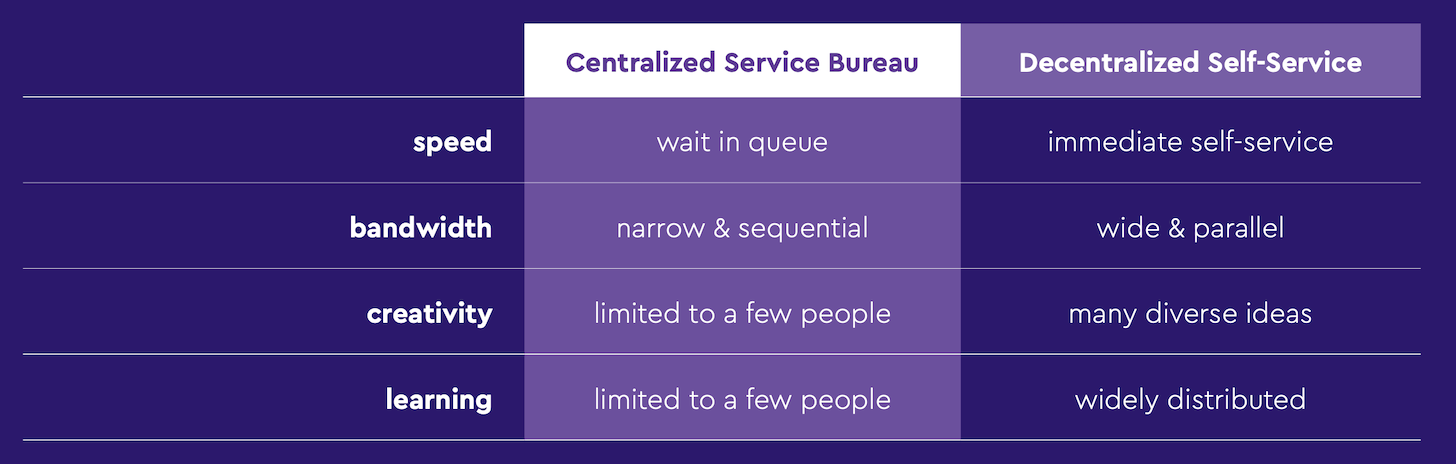
In numerous means, the significant AI assistants such as ChatGPT, Claude, and Gemini are über no code platforms, letting you develop an ever-wider series of electronic properties as needed. Groups who leaned right into these abilities have profited of better speed, transmission capacity, creativity, and understanding of decentralized self-service.
That claimed, governance and guardrails for citizen-created assets stay premature. Lots of organizations are still finding out how to balance empowerment with brand consistency and compliance. We’ll come back to this subject with Trend # 4 concerning Huge Ops …
Trend # 2: Systems, Networks & Marketplaces
If previous years were about companies maximizing linear chains– worth chains, supply chains, distribution chains– our teamed believe the framework and method of businesses would advance to increasingly be driven by interconnected graphs and ecosystems using systems, networks, and markets.
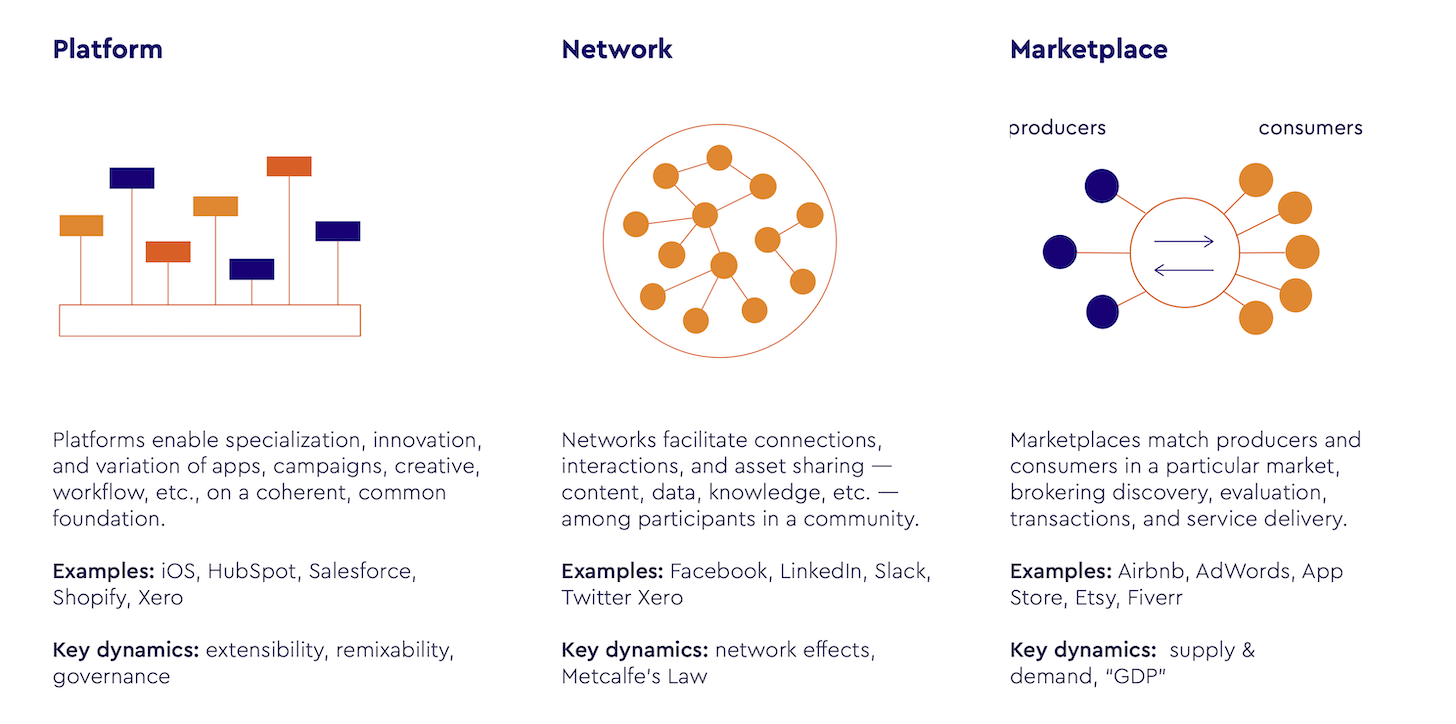
In martech, system environments have currently fully supplanted the old collection vs. best-of-breed dichotomy. (I was pleased to add to this shift as VP system environment of HubSpot, a duty I left this past September after 8 years of constructing the company’s ISV program from the ground up.)
Two of the most popular systems today are Databricks and Snow, which work as unviersal data layers that integrate throughout heterogeneous technology stacks. Most likely one of the most appealing platforms headed into 2026 though are the major AI engines, with MCP connectors and the emerging principle of ChatGPT Applications.
Networks were already common, but have actually expanded even more so. Digital markets have proliferated. I would say the most noteworthy ones in martech are the hyperscalers: AWS Market, Google Cloud Industry, and Microsoft Marketplace now transact an estimated $ 45 billion in annual venture software sales. Adobe, HubSpot, and Salesforce currently all deal products with this network.
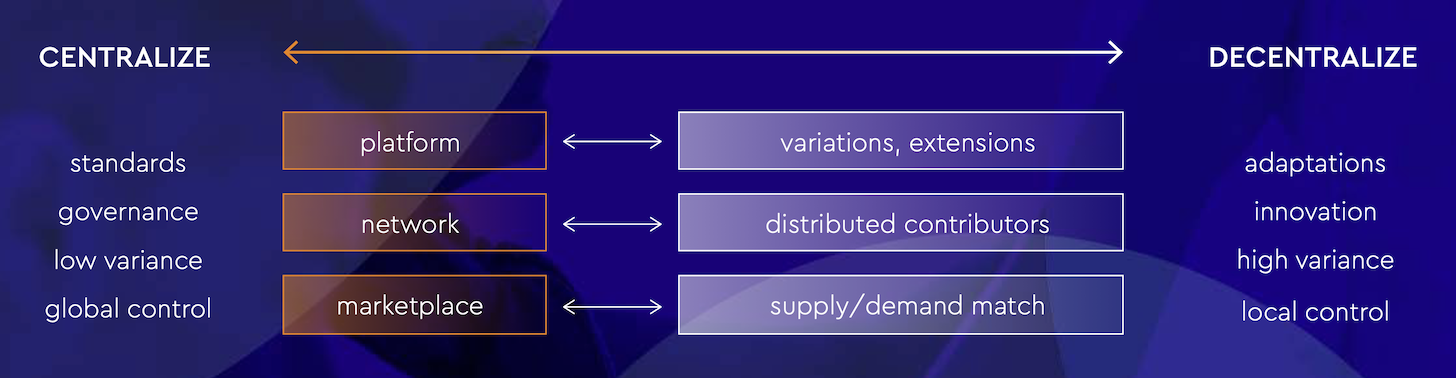
One seemingly paradoxical balancing act of systems, networks, and industries: it is via the streamlined control of standards and governance, when paired with technological and thoughtful visibility, that these community mechnisms drive decentralized development and advancement. You streamline to decentralize. It’s a little a Zen koan for the electronic age.
That’s partially why this is only an A-/ B+ so far. Environment dynamics are still brand-new for numerous firms, who choose the higher control they have– or a minimum of the impression of control– with even more straight, straight go-to-market approaches. Yet those are old mental models from a previous era. I’ll double down on my wager that ecosystems and the platforms, networks, and industries that animate them will certainly underpin advertising and marketing by the end of this years.
Trend # 3: The Wonderful App Surge
When we composed the Martech 2030 report, the 2020 martech landscape had 8, 000 remedies. As part of an annual practice, lots of people assumed that was “peak martech.” Yet below we remain in 2025 with virtually two times as several: 15, 384 commercial remedies on the map
Why hasn’t this consolidated? Really, it continually settles with competition and M&A. But because there are properly no barriers to entrance in software application– a trend that AI has dialed up to 11– new items continue to pour in at a faster rate than they drain pipes out.
Actually, it is the debt consolidation of hyperscaler cloud framework and significant app platforms that stimulated the blossoming of thousands of expert apps built on those structures. (Systematize to decentralize.) These apps comprise the lengthy tail (the loooooooong, lengthy tail) of the martech landscape: upright market applications, local apps, community applications, service provider applications, and an unending trend of start-ups aspiring to interfere with the incumbents.
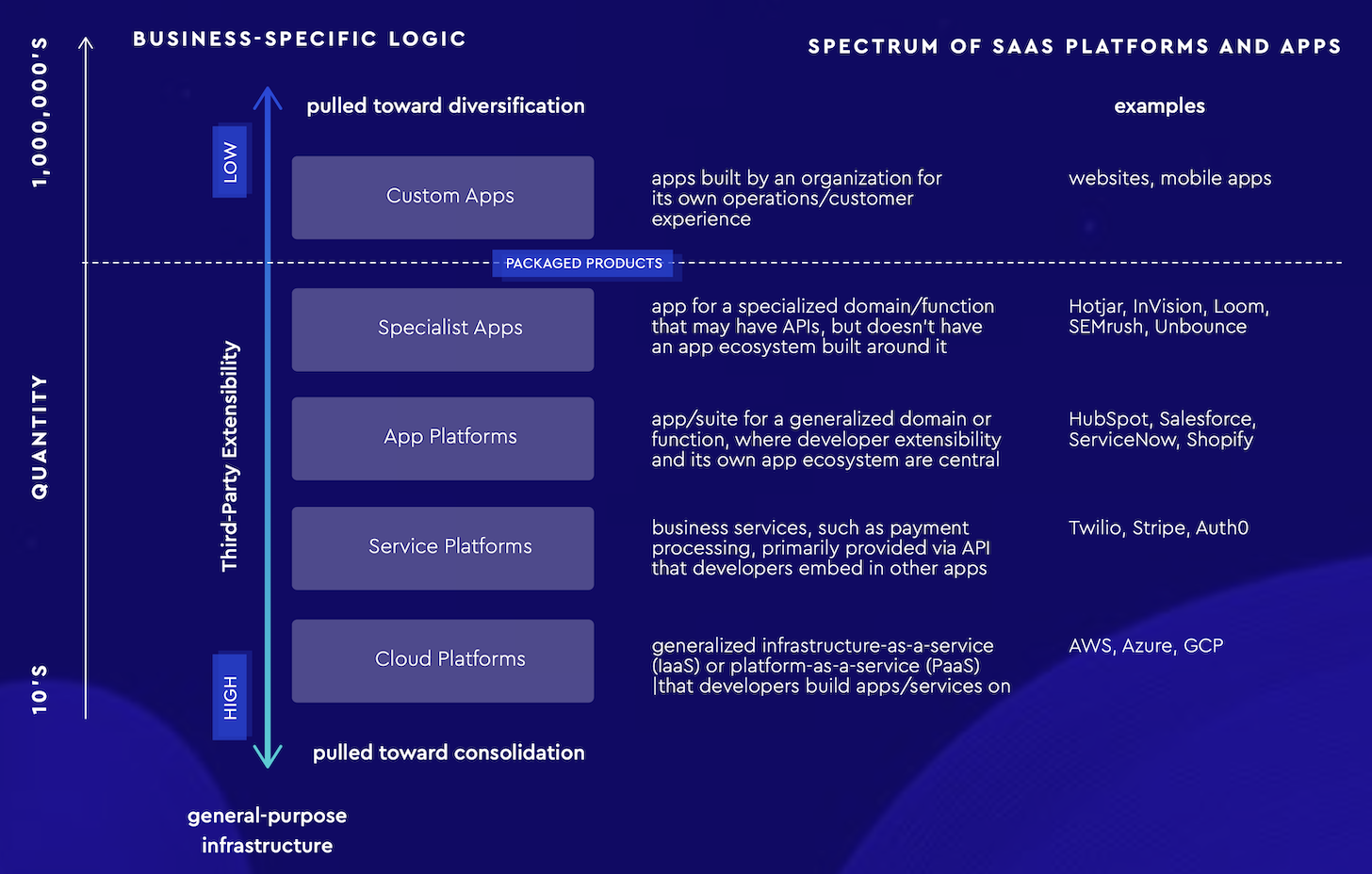
But we anticipated that The Wonderful App Explosion would certainly be also larger. Not thousands of applications. Billions of applications. The substantial majority personalized constructed by companies, customized to their own procedures and client experiences. While we anticipate the long tail of business martech will certainly continue to grow, it will be overshadowed by the hypertail of customized martech. (For even more concerning the hypertail, download our State of Martech 2025 and Martech for 2026 records from last springtime and this past December.)
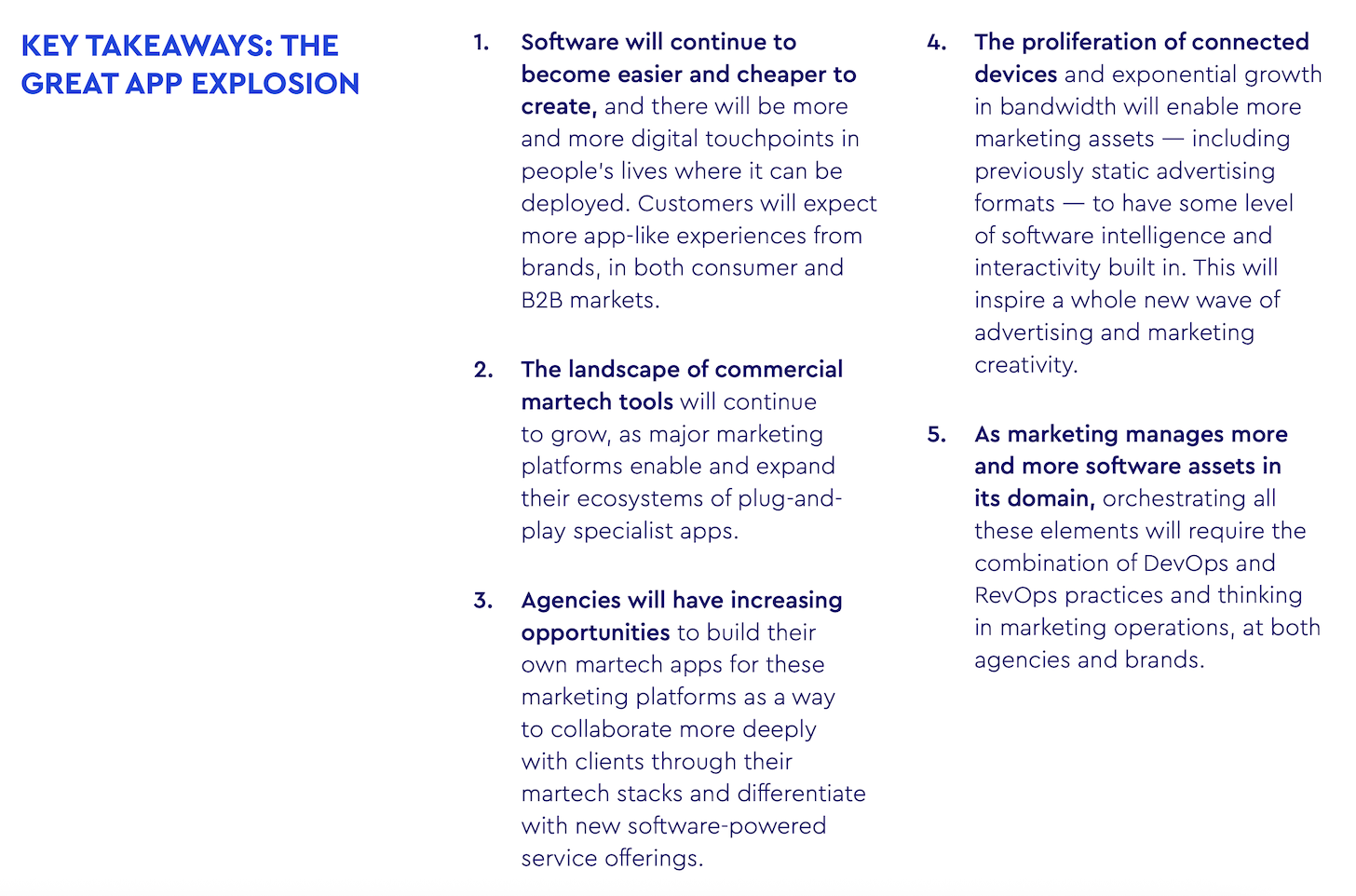
AI has actually delivered The Terrific App Explosion, and the hypertail is already flourishing today. Five forecasts we made within this trend are also materializing, including service-as-software (takeaway # 3 and the rise of intelligent/interactive marketing properties (takeaway # 4:
Fad # 4: From Big Information to Big Ops
We expected that the 2020’s would be a years of Big Ops. Similar to wrangling the range and complexity of Big Data, the goal of Huge Ops would certainly be to tackle and tame the scale and complexity of hundreds to hundreds of parallel apps, representatives, and automations operating that sea of information within a business’s procedures.
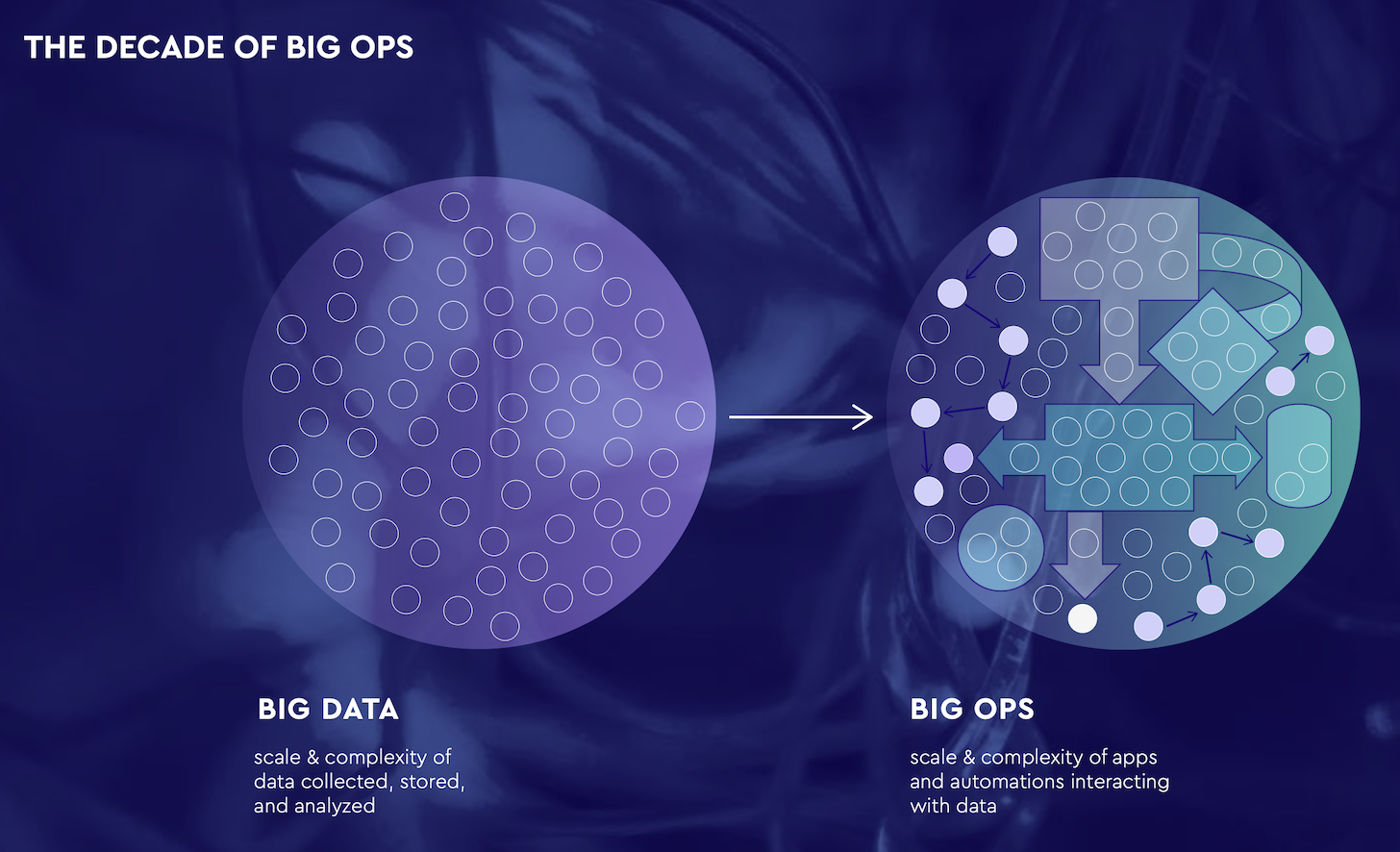
We properly called the problem– the chaos of unskillful “No Code” Resident Creators and The Excellent Application Surge– earning ourselves a strong B/B+. Solutions, both technological and organizational, however, are still arising. Practically every major platform in martech is focused on this problem/opportunity today, framed as “orchestration” and “decisioning.”
This is going to be the system fight for the rest of this decade. Order your snacks.
Data is a critical possession in Huge Ops. Yet its worth is only opened via its purification and activation, which we referred to as information intelligence and data relfexes One of my favorite allegories from our record: information is not the brand-new oil, it is the brand-new oil paint. Huge Ops is how we go from pigments on a palette to masterpieces on a canvas.
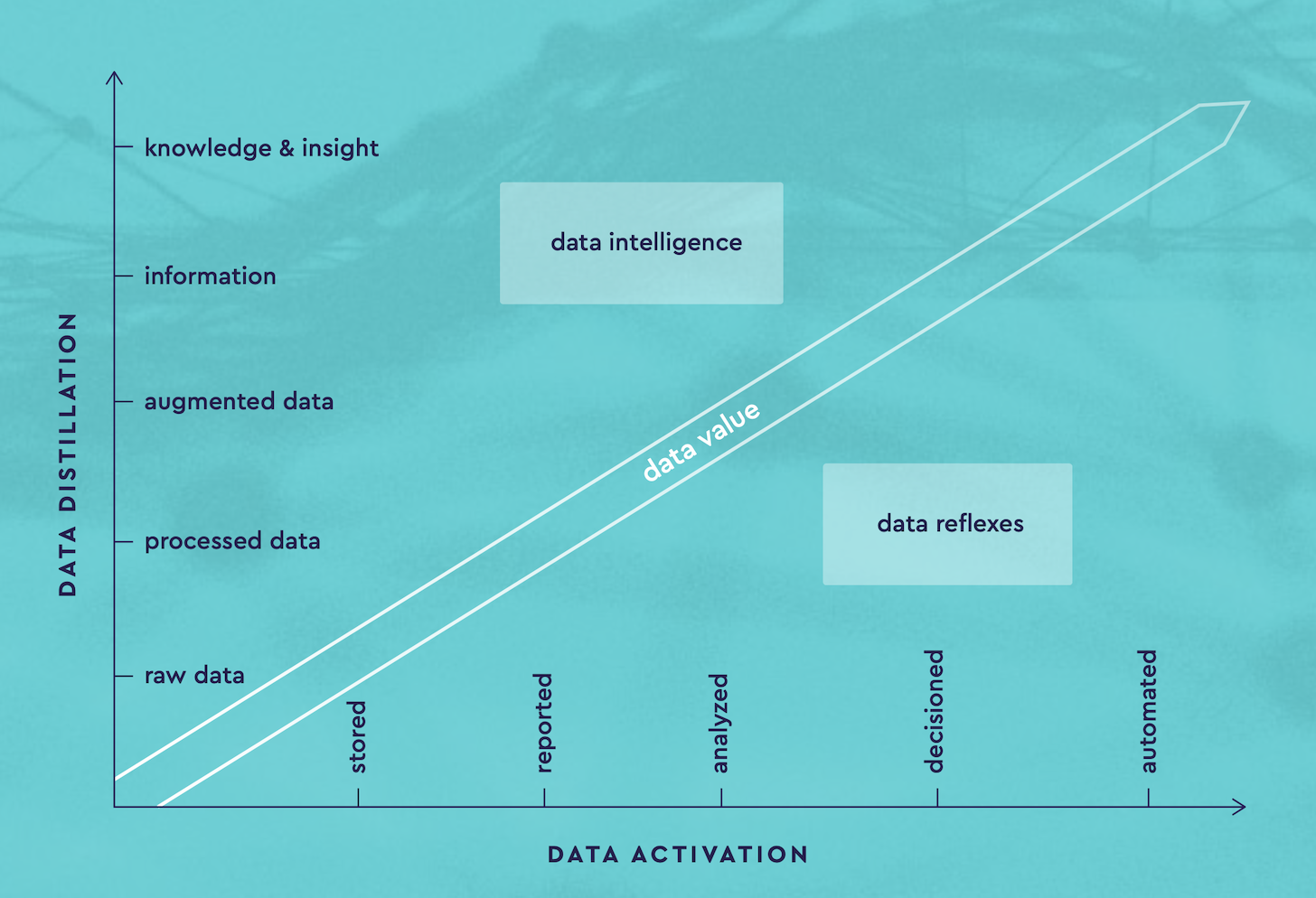
It’s the complication of Big Data and Big Ops that placements Databricks and Snowflake– in addition to the hyperscalers AWS, Google, and Microsoft– as serious competitors in the Orchestration Wars.
It will certainly be a frenzy of coopetition in between them and the general public martechs (e.g., Adobe, Braze, HubSpot, Salesforce, Zeta), evolving CDPs (e.g., Hightouch, Tealium, Syncari, Prize Data, Twilio), agent/automation platforms (e.g., CrewAI, n 8 n, Make, Workato, Zapier), a wave of next-gen martech startups (e.g., GrowthLoop, iCustomer), and even the AI titans Anthropic and OpenAI.
Going to require more snacks.
Trend # 5: Harmonizing Human Beings + Makers
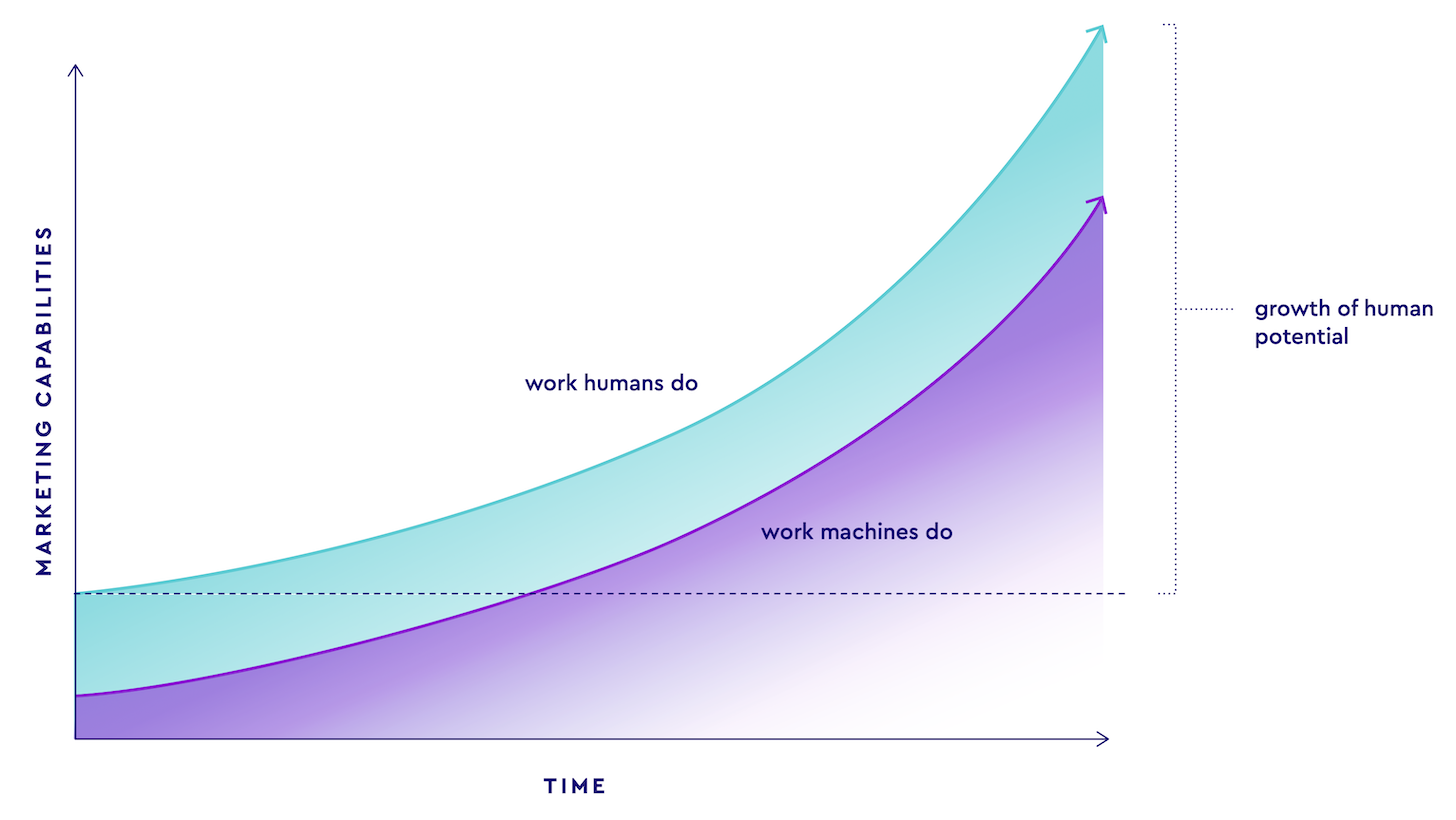
“Greater automation and AI support will provide marketing experts even more time and new devices to focus on consumers, creativity & development.” If we made that forecast today, the response would be “no duh.” But five years back, this was prescient. The graph we laid out listed below is practically precisely just how this is playing out.
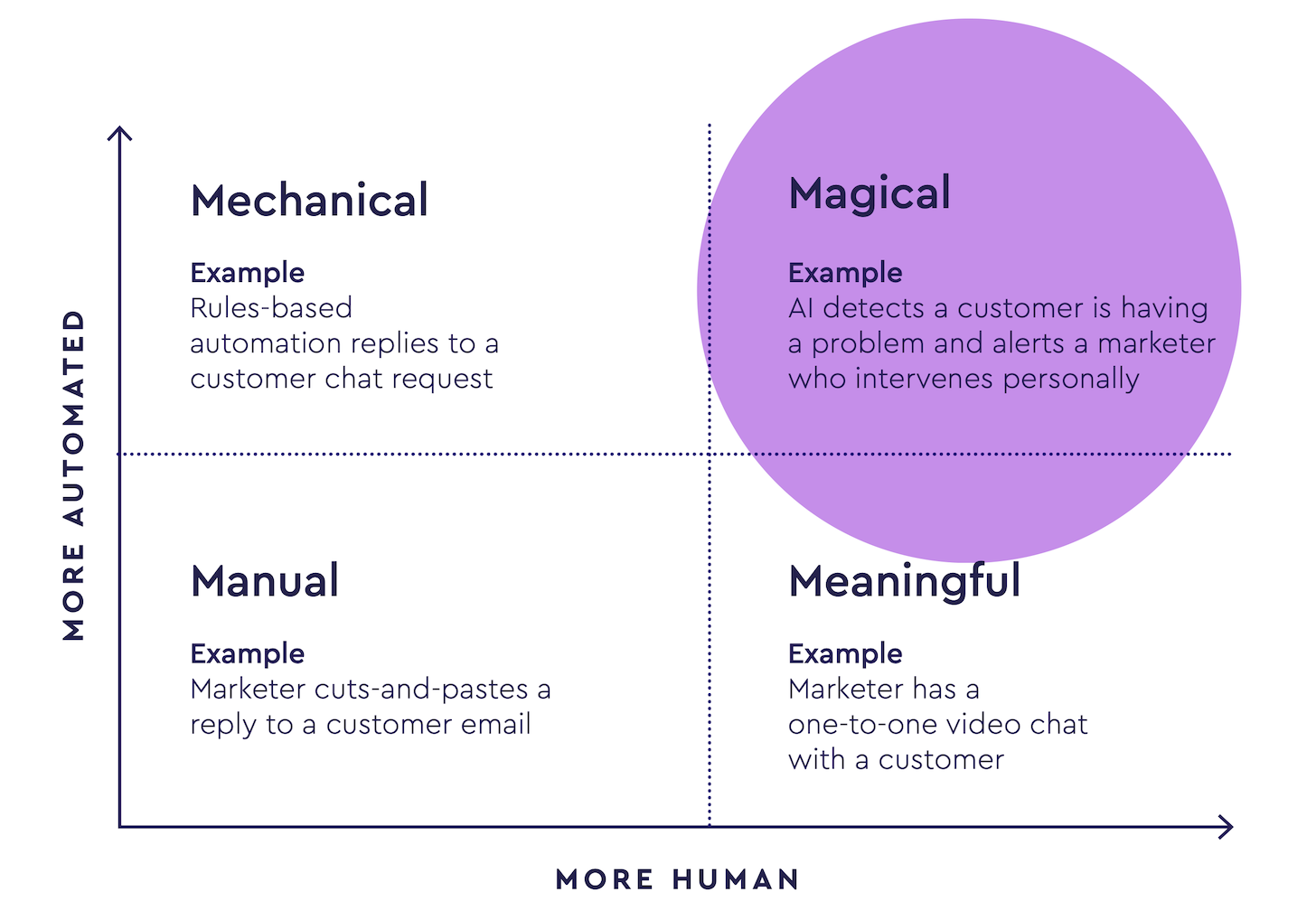
We kept in mind that automation and human interaction aren’t always equally unique, and when effectively synthesized together can provide wonderful experiences:
We also expected the rise of buyer-side AI, which emerged as a market pressure in 2025 with Agents of Customers What we pictured in 2020 as a change from SEO to BBO (Buyer Bot Optimization) is the sensation we’ve come to know as search engine optimization to AEO (AI Engine Optimization). What we forecasted as Crawler Business is currently called Agentic Commerce.
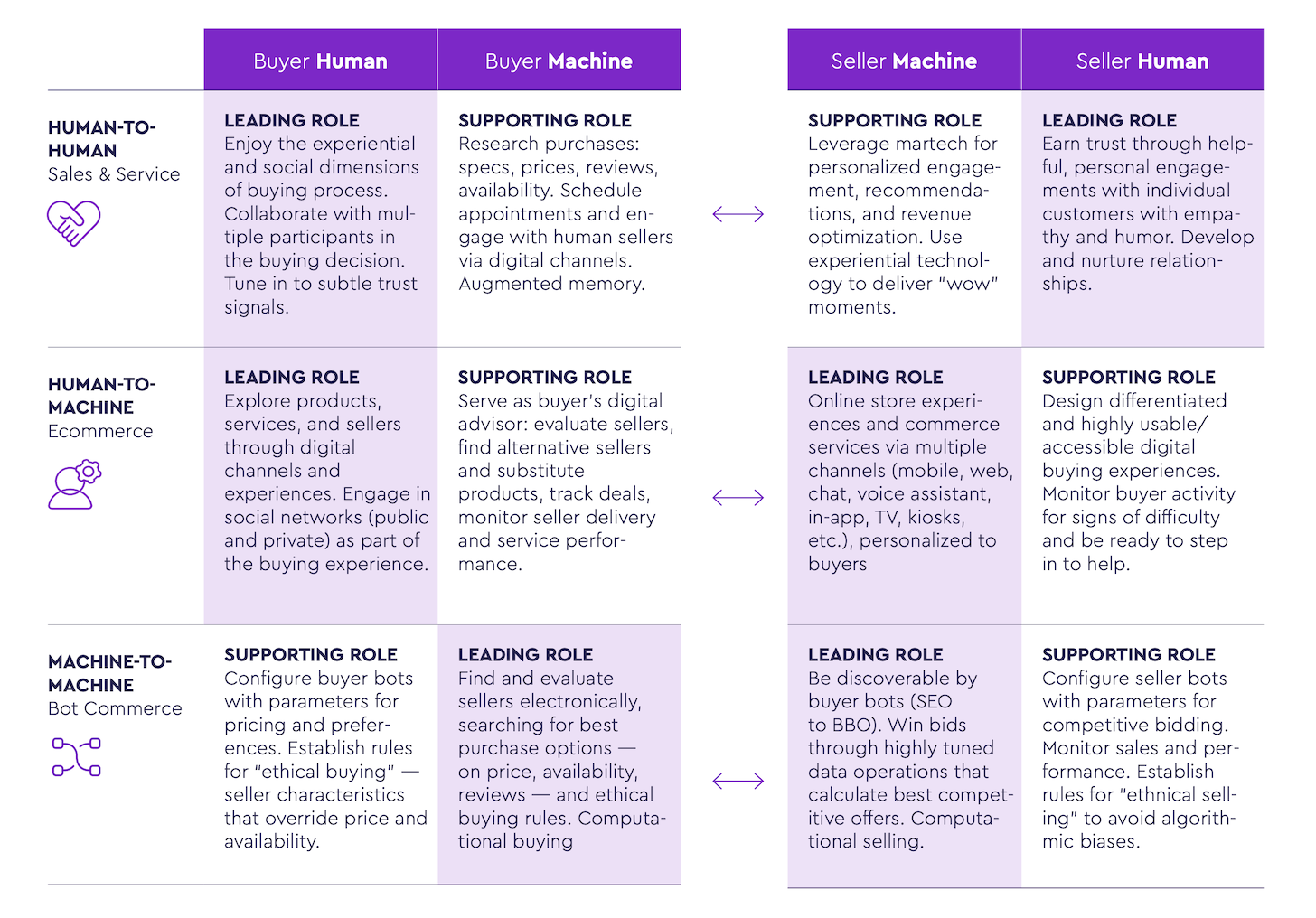
The tags we have actually landed on are cosmetically different, however the AI concepts we specified 5 years back have actually gone across from concept into reality. I assume we earned our A+’s here, no?
Final thought
What do you believe? Did the ChatGPT, Claude, and Gemini quality us fairly?
Amara’s Law states that we have a tendency to overstate the temporary impact of modern technologies but undervalue their long-lasting effects. The goal we had with our Martech 2030 paper was to consider that long-term arc. While these five trends are still evolving, it’s remarkable just how much they’ve can be found in these previous couple of years. The pace is accelerating.
For much better and even worse, I don’t assume it will slow down in 2026
Allow’s revisit this paper again in 2030 for final qualities.
Suggested AI Advertising And Marketing Tools
Disclosure: We might earn a payment from affiliate links.
Original protection: chiefmartec.com
Leave a Reply