
Five days compressed right into five minutes. Six weeks into six days.
These aren’t minimal enhancements. They’re what happens when marketing organizations get rid of the architectural obstacles that prevent gifted individuals from acting at the speed of customer actions.
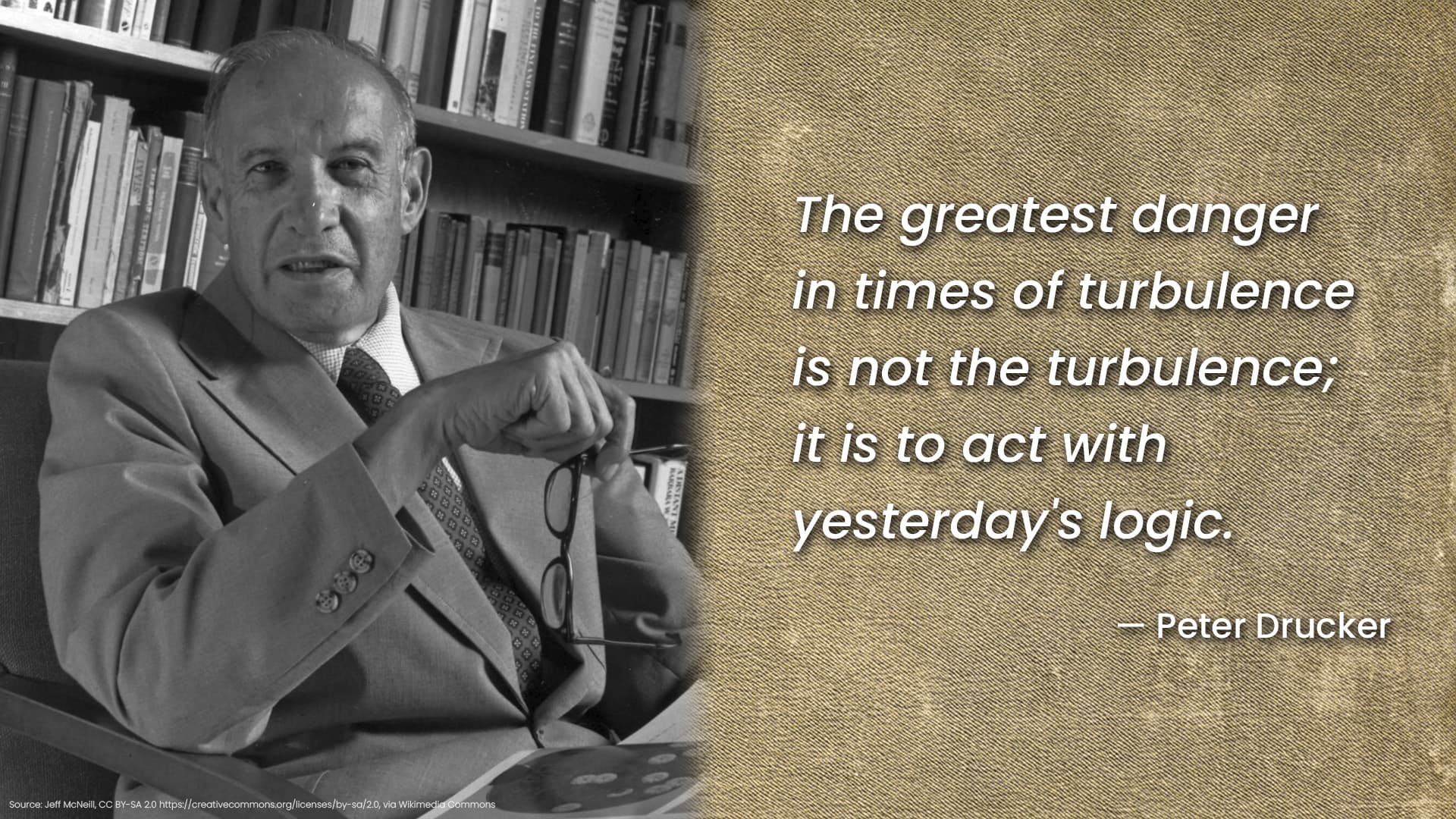
As Peter Drucker, the daddy of contemporary administration , alerted in “Taking care of in Stormy Times,” “The greatest danger in times of turbulence is not the turbulence; it is to show the other day’s reasoning.”
Markets are volatile. Customer actions changes in actual time. Networks are always on. Yet lots of advertising and marketing companies still operate with frameworks made for a slower globe, and the cost is determined in missed minutes.
Drucker determined the actual constraint: Structure limits performance
One of Drucker’s most enduring ideas was that organizational structure matters more than specific capacity. Smart individuals entraped in the incorrect system will still underperform.
Take into consideration an international video gaming operator that needed seven teams to launch a single campaign. Planning cycles extended to 6 weeks. As their Worldwide Head of Customer Advertising and marketing placed it: “We required seven groups and 6 weeks to send out a single project.”
This wasn’t a talent trouble. When insights live with analysts, imaginative implementation deals with developers and activation depends on engineers; value is lost in the handoffs. Choices slow-moving. Context degrades. Minutes pass.
Drucker alerted against this fragmentation. He thought knowledge workers required both clearness of function and flexibility of action. Positionless Marketing eliminates the architectural barriers that protect against that freedom.
From knowledge job to moment-based execution
At one of the biggest iGaming business in the U.S., project implementation took five days. In an atmosphere where gamers place wagers, browse items or program signs of disengagement in actual time, 5 days is an endless time. The chance to act shows up and disappears virtually immediately.
By settling consumer information, orchestration and execution, getting rid of the handoffs that killed energy, they lowered campaign implementation to 5 minutes. A 99 % decrease in cycle time.
This mirrors what Drucker constantly promoted: choices made near to the action, by the individuals with one of the most context. Positionless Advertising allows marketers to move from understanding to action without waiting on approvals or cross-functional workflows.
The influence surpasses speed. They can currently more conveniently route a meaningful percentage of spend to their most deserving gamers. It means better choices, executed promptly.
From management by goals to execution by results
Drucker introduced “monitoring by purposes” to align organizations around end results rather than tasks. With time, advertising and marketing wandered back towards task conclusion: construct the campaign, launch the possession, step later.
The global pc gaming operator’s change brought this ideology cycle. After restructuring around Positionless principles, they reduced campaign time from six weeks to hours, and often a single day.
However the actual shift was liability. In the past, they had shared obligation, which truly suggested no obligation. Currently, a single marketing expert possesses a project lengthwise. They construct it. They release it. They gain from it.
The objective is no more to send out a message; it’s to drive an action. Not to introduce a trip, however to alter habits. Not to complete a procedure, yet to create value in the moment.
As Drucker placed it in” The Effective Executive ,” “Effectiveness is doing things right; effectiveness is doing the appropriate points.” Positionless Advertising prioritizes efficiency by allowing marketing professionals to determine and act immediately.
Real-world evidence: Organizations relocating at the speed of communication
The pattern repeats throughout markets. Organizations adopting Positionless Marketing principles see comparable outcomes:
Campaign implementation cycles collapse from days to mins. Teams avoid seven to one. Planning horizons compress from weeks to hours. But the outputs improve– even more individualized, more appropriate, more reliable.
These aren’t technology wins. They’re structural transformations. Organizations have moved from assembly-line advertising to empowered execution– from dependency to ownership.
What changed? They stopped arranging around functions (data, imaginative, activation) and began organizing around end results. They provided individual marketing professionals the authority and tools to relocate from understanding to activity without handoffs.
They became Positionless.
Modern technology as an amplifier of judgment, not a replacement
Drucker was clear that devices ought to sustain human judgment, not replace it. Modern technology’s worth hinges on speed and range, not knowledge.
The companies doing well with Positionless Marketing embody this concept. AI gives prediction and referrals. Automation gets rid of friction. Yet judgment on what to do, when to do it, and why continues to be with the marketer.
With all consumer data and orchestration devices in one place, marketing experts don’t need to wait on designers to target checklists, experts for understandings, or creative groups for content assets.
Strategic judgment is currently enabled by innovation, not replaced by it. This is why Positionless Advertising isn’t around doing more job. It has to do with allowing far better decisions to be performed promptly. In Drucker’s terms, it makes the expertise employee productive.
The advancement Drucker prepared for yet can not completely describe
Drucker visualized flatter organizations, faster decision-making and greater autonomy. What he could not prepare for was a world where consumers are always attached, channels are constantly on, and significance expires instantaneously.
Because world, understanding without implementation is thrown away possibility. Framework without versatility is a liability. Expertise without ownership creates traffic jams.
Positionless Advertising and marketing is the following rational action in Drucker’s approach. It provides marketing professionals what knowledge employees were constantly meant to have: Immediate accessibility to details, clear authority to act, and accountability for outcomes rather than tasks.
What was as soon as a production line requiring 7 teams has actually ended up being something a single online marketer can own end-to-end.
As Drucker cautioned, the best risk in unstable times is remaining to run with yesterday’s reasoning. Advertising and marketing groups that still count on yesterday’s assembly-line frameworks will continue to miss today’s minutes.
From philosophy to exercise
If Drucker defined what expertise employees require to be reliable, Positionless Marketing defines how marketers can lastly work that way in genuine time.
It changes waiting with activity. Five-day process end up being five-minute actions.
It changes handoffs with possession. Seven-team procedures come to be single-marketer implementations.
It replaces process-driven execution with moment-driven significance allowing brand names to relocate at the speed of a consumer’s interaction.
The inquiry is no more whether marketing organizations need to transform. It’s whether they’ll alter before their competitors do.
The understanding worker Drucker envisioned is no longer simply educated. In advertising and marketing, they are ultimately encouraged to act. They are Positionless. To see the examples referenced in this write-up: go to study 1 , and right here study 2
Viewpoints expressed in this article are those of the sponsor. MarTech neither confirms nor disputes any one of the verdicts provided above.
Recommended AI Advertising Equipment
Disclosure: We may make a commission from affiliate web links.
Initial protection: martech.org
Leave a Reply