
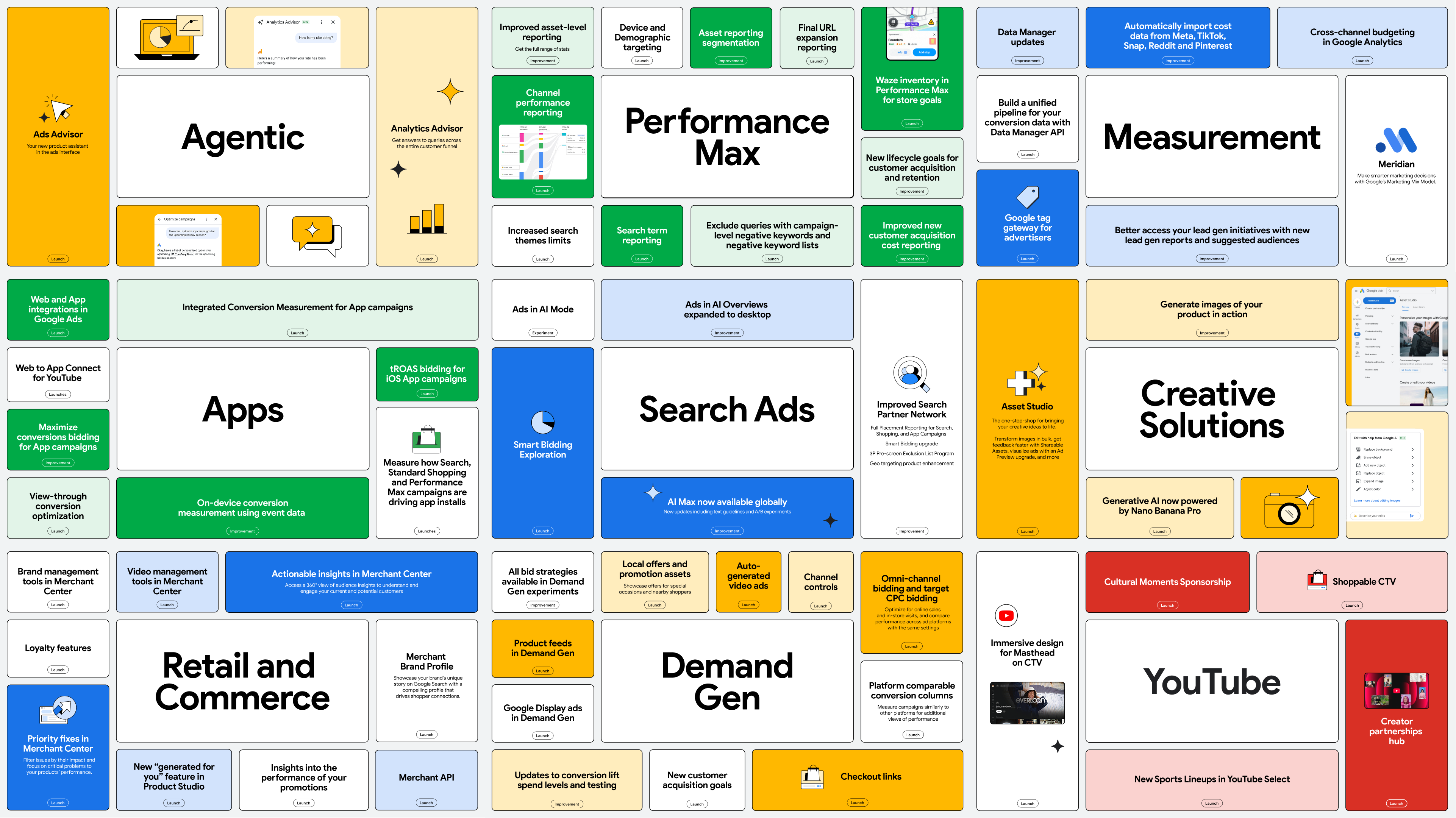
As December is swiftly ending, Google released its 2025 Year in Testimonial, with a complete checklist of item launches, upgrades, enhancements all driven by AI.
These updates showed up across the board in Search, YouTube, Need Gen, Efficiency Max, Merchant Facility, and more.
Some updates seemed like all-natural progressions from earlier launches. Others pressed Google’s vision for a more computerized, much more visual, and much more data-informed advertisement system right into clearer sight.
For pay per click supervisors and directors that invested the year screening generative AI, adjusting to brand-new coverage controls, and reassessing creative workflows, Google’s wrap-up is a beneficial method to recognize what really formed paid media in 2025 and what still needs refinement.
The Most significant Releases of 2025
Prior to breaking down the styles and ramifications, right here is a picture of the major updates Google highlighted in its year-end wrap-up:
- Ads in AI Overviews broadened to desktop computer and new international markets
- AI Mode opened new mid-funnel supply for much deeper conversational inquiries
- The launch of AI Max for Look, with new beta features being released in Q 1 2026
- Smart Bidding process Expedition allowed for versatile ROAS targets
- Full placement reporting expanded throughout the Search Partner Network
- YouTube released Shoppable CTV, new Social Minutes Sponsorship, brand-new sporting activities schedules, and a developer collaborations hub
- Need Gen added item feeds, target CPC bidding, campaign-level experiments, and channel controls
- PMax got channel-level reporting, complete Browse Terms, asset-level metrics, unfavorable keyword checklists, gadget targeting, and expanded search themes
- App projects boosted iphone measurement, Web-to-App flows, ROAS bidding, and conversion modeling
- Vendor Facility gained brand profiles, AI-powered visuals, loyalty devices, and concern fixes
- Meridian introduced an open-sourced MMM method with reduced lift limits
- Data Manager and Google tag gateway made data precision and loan consolidation simpler
- Property Studio released inside Google Ads with Nano Banana Pro powering photo and video clip development
- Advertisements Consultant and Analytics Advisor delivered assisted assistance for project building and evaluation
Taken with each other, these updates show Google’s continuous initiative to mix automation with marketer control, though some locations are maturing faster than others.
Below are information of some of the key updates worth digging into much more.
Exactly How Google Repositioned Search for the Next Era
Google spent a lot of 2025 redefining exactly how Search jobs, particularly around discovery minutes and conversational intent. These shifts matter due to the fact that they establish where advertisements can appear and how very early advertisers can influence a buying journey.
Ads in AI Overviews
Google increased Ads in AI Overviews throughout desktop and international markets. This placement rests inside AI-generated summaries and provides advertisers a possibility to appear prior to individuals have actually clicked right into a standard results page. While Ads in AI Overviews was introduced earlier this year, it wasn’t up until the later component of 2025 where individuals were sharing their screenshots in the wild.
AI Mode
Still in testing, AI Setting addresses multi-step or nuanced inquiries with structured actions. Google currently enables ads to appear below and within these feedbacks when relevant. These minutes previously had actually no paid supply, so this is a new mid-funnel possibility for marketers who intend to influence intricate decision-making.
AI Max for Search
AI Max prolonged its function set and remains among Google’s fastest-growing Search products. Experiments, innovative standards, and message modification offer advertisers a lot more agency over AI-generated properties. The difficulty is handling expectations. AI Max streamlines configuration yet still calls for critical human oversight to shape relevance and cost effectiveness.
Smart Bidding Process Expedition
Google pointed out a typical 18 percent rise in distinct transforming inquiry categories and a 19 percent conversion lift when advertisers used flexible ROAS targets. For brand names that battle to broaden reach without spending too much, this might become one of one of the most sensible levers in 2026
YouTube and Demand Gen Proceeded Their Development Spurt
YouTube provided several of Google’s a lot of impactful upgrades this year. Shoppable CTV enables viewers to surf items straight on the big screen or pass the experience to their phone.
Social Minutes Sponsorships produced a packaged technique for brands that want existence during tentpole events. With new sporting activities lineups throughout college and ladies’s organizations, Google is wagering heavily on online and fandom-driven settings.
Demand Gen likewise saw meaningful renovation. Google kept in mind a 26 percent increase in conversions per buck driven by more than 60 AI-powered improvements.
Incorporated with product feeds, channel controls, and full compatibility with Customized Experiments, Demand Gen now seems like a developing style as opposed to a speculative follower to Discovery.
Efficiency Max Became Much More Transparent and Much More Manageable
Performance Max obtained a collection of lengthy overdue coverage and control attributes that altered the amount of marketers functioned inside the platform.
Network reporting, complete Search terms, asset-level understandings, client acquisition exposure, and division choices allow pay per click managers recognize where performance comes from. Unfavorable keyword phrase listings, tool targeting, market controls, and broadened search themes finally offered marketers the ability to tighten or increase performance purposefully rather than reactively.
For numerous teams, this was the year PMax really felt less like a ‘take-it-or-leave-it’ automation tool and even more like a high-powered project structure that requires guidance as opposed to blind count on.
Imagination Ended Up Being a Main Emphasis
One style that Google stressed much more strongly this year was imaginative high quality and process performance. With Property Workshop and Nano Banana Pro, Google is indicating that innovative is no longer a side part of performance. It is a core lever.
Possession Studio
The brand-new in-platform innovative work space lets marketers produce, edit, and evaluation imaginative straight inside Google Ads. Nano Banana Pro currently sustains:
- All-natural language modifying
- Seasonal variants
- Photorealistic item scenes
- Multi-product compositions
- Mass photo generation
- Shareable assets for group review
For lean teams that struggle to produce sufficient aesthetic variation for PMax, Need Gen, or YouTube, this removes a significant traffic jam. The high quality still varies depending on brand name design, appearance, or illumination, yet Google is clearly positioning AI-assisted creative as a foundational aspect in project arrangement.
Advertisement Sneak Peek and Process Support
Updated sneak peeks show advertisements throughout channels without uncertainty, and shareable sneak peeks remove a great deal of rubbing with internal stakeholders. This is one of Google’s even more underrated releases because it straight fixes an usual workflow difficulty: straightening innovative teams and media groups without prolonged back-and-forth.
Google also introduced Ads Advisor, a directed AI aide for project building and troubleshooting, which decreases functional problem for teams who manage several accounts or frequent experiments.
Why the iOS Measurement Updates Are More Important Than It Looks
Buried within Google’s 2025 recap was an upgrade most marketing professionals will certainly skim past, but app-focused marketers immediately viewed as one of the most significant enhancements of the year.
Google increased Web-to-App acquisition measurement for iphone, enabling advertisers to track when a customer relocates from an internet project into an application install that eventually brings about a useful in-app action.
On the surface, this reads like a tiny coverage improvement. In practice, it solves one of one of the most frustrating voids in iphone app advertising and marketing because ATT went live in 2021
For most marketers who run typical lead-gen or ecommerce campaigns, this update will certainly feel far-off. But for app online marketers, it finally closes the loop on a customer journey that made use of to look fragmented, irregular, or completely unnoticeable.
Below’s what makes it so vital:
- It brings back visibility that application advertisers shed years back. After Apple’s App Tracking Openness rollout, several advertisers shed the ability to see just how internet projects affected app installs. That suggested paid Search, Shopping, and even PMax frequently underestimated app development, since installs and in-app actions didn’t get connected properly. Google’s brand-new iphone Web-to-App measurement begins bring back that course, which helps app projects get credit scores where it was formerly impossible.
- It allows advertisers to optimize for higher-value activities, not just mounts. Before this update, the disconnect between internet website traffic and application conversions usually pressed advertisers towards shallow optimization goals. Now, Google can link in-app activity quality back to upstream projects. For app marketers, that means smarter bidding. For financing teams, it implies cleaner forecasting.
- It makes cross-surface technique sensible once more. Many app brands market throughout Look, YouTube, Buying, and PMax but needed to deal with those touchpoints separately. This upgrade reopens the door to a unified approach, where imaginative, bidding process techniques, and budgets can line up with actual user habits as opposed to being fragmentised by platform restrictions.
App-focused teams have actually been browsing unseen areas for many years. They understand how often internet website traffic influences application installs. They have actually seen how many high-value users begin on mobile web before downloading and install. Without visibility, they have actually had to rely on directional data, blended coverage, or pricey workarounds with MMP partners.
This update doesn’t resolve every attribution restriction on iphone, yet it does provide app advertisers something they have actually wanted given that ATT: a course to comprehending the real value of web-driven application conversions.
It produces a more total and sensible dimension loop, which is exactly what Google needs if it desires marketers to spend with confidence in App campaigns throughout Browse, YouTube, Need Gen, and Efficiency Max in 2026
Where There’s Area for Improvement
A year-in-review needs to not only highlight progression yet additionally acknowledge where marketers still experience friction. My objective below is objective review without negativeness.
AI Overviews require more clear uniformity
Marketers still battle to forecast when AI Overviews will show up and how typically advertisements surface within them. Before this ends up being an essential surface area, Google needs much more stability and more clear guidelines.
Creative control in AI Max is not completely foreseeable
Google is increasing personalization setups, yet marketers still see unanticipated rewrites or over-simplifications. More transparency around why AI selects particular variants would help creative groups align expectations.
Possession Workshop result varies by category
While the brand-new devices are fast and adaptable, specific item kinds still create inconsistent or excessively elegant visuals. This will improve, however brand names that count on stringent aesthetic identification might require hybrid process in the meantime.
Dimension unification is still a difficulty
Meridian is promising, yet marketers desire easier positioning in between Google’s lift results and those from Meta, Amazon, or independent MMM devices. The market needs consistency, not isolated acknowledgment logic.
These spaces do not diminish the relevance of Google’s updates, but they advise us that AI-led advertising is still developing and needs both testing and hesitation.
Completing the Year
Google’s 2025 recap revealed a system that is progressing quickly yet developing steadily. Automation is no longer something advertisers fear or resist. The discussion has actually moved to just how pay per click teams can direct these systems with clearer insight, smarter screening, and much more deliberate innovative work.
If 2025 had to do with opening exposure and control, 2026 will have to do with applying those devices with technique. Marketers who lean right into trial and error, innovative differentiation, and information strength will certainly be the ones who remain in advance as Google’s ad environment remains to transform.
What was your biggest takeaway from Google’s updates this year?
Suggested AI Advertising Devices
Disclosure: We might make a payment from associate web links.
Initial coverage: www.searchenginejournal.com
Leave a Reply