
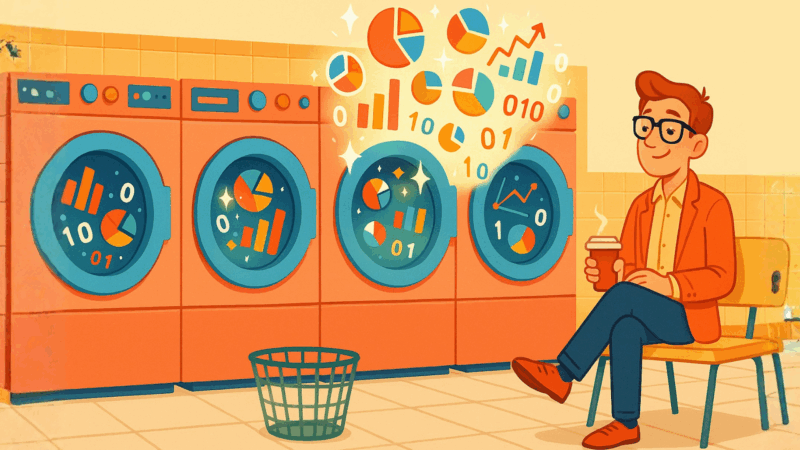
Data was suggested to make marketing smarter. Someplace along the way, it made us forget what we were trying to recognize to begin with.
The hollow equipment
For the majority of my career, I thought advertising was a bridge between creativity and business– in between what brand names make and what people genuinely desire. I held senior functions in electronic advertising and marketing, leading campaigns that reached millions. I had every device: control panels, KPIs, analytics and understanding engines. I believed that if we measured, enhanced and customized sufficient, we could make advertising and marketing clinical.
Yet something was off. The control panels looked remarkable– full of graphs and metrics– yet they were worthless. We would certainly celebrate a 3 % lift also when absolutely nothing actually transformed. The information really did not attach to income, commitment or human connection. Multimillion-dollar command centers worked on unverified or made information. Campaigns on systems like Facebook and Google relied on metrics that barely mirrored genuine outcomes. We were presuming rather than knowing, pretending as opposed to understanding.
Gradually, advertising changed from asking why individuals really feel something to just how to make them feel something– generally necessity, envy or insufficiency. We called it involvement, yet it was control, systematized at range. Inside the equipment, departments competed for credit history as opposed to placement. Agencies chased awards rather than influence. We constructed projects to impress each various other, not to offer the individuals we declared to recognize.
When I left company life to begin my own consulting, I saw what my occupation had actually covered: misaligned models, denial-driven societies, items no one required and tales nobody thought. Underneath everything was the force nobody wished to call– unclean data– sustaining phony precision and manufactured insight.
However the deeper issue was corruption of motivation. And nowhere is that impression clearer, or more dangerous, than in the dirty information economy that offers the dream of control while quietly removing everything you’re worth.
Dig deeper: Why the scam economic situation is eliminating both advertising and marketing experts
How the filthy information economic situation possesses you
Have you ever downloaded and install one of those applications that promise to pay you for responding to a couple of surveys? I recently attempted one called Studies On the move, which, according to its homepage, is “the country’s largest, highest-rated survey app.” The touchdown web page is exactly what you ‘d expect: a collage of stock-photo smiles radiating the kind of generic joy just an advertising department could acquire.
In the beginning glimpse, it appeared harmless– address a couple of questions, make a few dollars. Yet as opposed to simply taking a study, I ran the application’s Regards to Solution and Privacy Policy with the Clean Data GPT I developed to see what I was really consenting to. What it discovered was staggering.
More than 25 problems prefer the business, including background data collection through geolocation and sharing it for behavioral analysis. Your point of views, habits and motions are generated income from, offering you pocket change while creating beneficial long-term behavioral profiles.
Below’s what the small print you’ll never ever read– yet must– actually states:
- Over 10, 800 words of terms and 6, 200 of personal privacy plan : Longer than a novel, and you’re expected to absorb it all with a single tap.
- “I concur” = Total surrender : You turn over survey responses, device ID, area, demographics, browsing background, application use and even presumed habits.
- An international, perpetual certificate : They can use, modify and sell your data permanently without more authorization.
- Unrevealed partners : Marketers, data brokers and various other third parties you’ve never heard of and can not opt out of independently.
- Guidelines can alter anytime : Maintain using the application and that counts as permission, even if you never ever saw the updates.
- No real opt-out : Erasing the app doesn’t remove the information already collected or offered.
This exact same system fuels Huge Tech– Meta, Google, Amazon– and information brokers like Experian, Oracle and Acxiom. Their operating principle remains the same: overwhelm individuals with small print, gather every possible data factor and keep it forever. Every retargeted banner and “suggested for you” punctual is industrialized affection.
- Meta’s Terms of Solution, for instance, provide it the right to utilize your material and communications to train its algorithms, target you with ads and infer your feelings even after you delete an article.
- Google’s Personal privacy Plan allows it to combine your search background, area data and Gmail content to construct a linked behavioral dossier that marketers proposal on in real time.
- Amazon tracks not only your acquisitions however likewise your browsing hesitations (i.e., how much time your arrow floats over an item) to anticipate and influence acquiring choices.
- Information brokers quietly buy, blend and resell hundreds of attributes concerning everyone, income level, political leanings, connections and health conditions, to any person going to pay. A lot of this takes place without authorization, without recognition and without settlement.
Apps enjoy to discuss rewards and user value, however it’s really data extraction dressed up as generosity. They want compliant individuals, not informed ones. That’s why approval is minimized to a solitary faucet: “Accept.” Just like that, they possess your clicks, area, state of minds and patterns. You’re pushed, pinged and gamified into entry. FOMO, deficiency timers and streaks are created to hook individuals, not to aid them.
Your information is silently sold a darkness economic situation you never ever decided right into, fueling projects that feel more like surveillance than solution. Personalization is just a polite word for profiling. Individuals aren’t involving since they feel comprehended. They’re responding due to the fact that they really feel enjoyed. These systems wear down commitment and type exhaustion, anxiousness and the creeping sense that you’re not making use of the app– the app is utilizing you.
Prioritizing openness and fairness over removal has never ever been even more immediate. The current system is working exactly as created: to accumulate, hide and profit. Turning around that will certainly take more than privacy spots or PR-friendly consent updates. It calls for reconsidering that has information, that regulates it and that benefits from it.
Dig deeper: Personal privacy is the brand-new currency in digital marketing
Building the clean data economic climate
That awareness brought about the production of the Marketing Liability Council (MAC), meant to face a sector that had lost its conscience. MAC wasn built to subject advertising’s illusions– the misconception of data-driven integrity, the corruption of authorization and the efficiency of principles without compound.
Throughout a series of MAC conferences, the frontage began to fracture. We encountered the reality that our approaches relied upon jeopardized inputs: dirty data, deceitful metrics and black-box acknowledgment versions. We had traded reality for performance theater, operating inside a system that rewards control– where adtech pretends to anticipate and brands pretend to care. Surveillance was sold as personalization, perceptions as influence, control panels as fact.
That thinking changed the concern from “exactly how do we do much better?” to “what do we develop instead?” Responsibility had not been enough. To rebuild trust fund, we required framework. That idea brought about the Clean Information Partnership (CDA), an initiative to reconstruct the electronic economic situation on openness, fact and human firm instead of exploitation.
Along with MAC, CDA is developing a structure where confirmed, permissioned information can outperform deception– what we call information firm. It provides individuals genuine control over their info and the right to choose that uses it and just how. The objective is basic: make fact more profitable than deception.
Why can’t I alter it from the inside?
Couple of profession organizations in marketing are taking this stand. A lot of safeguard the status. Teams like the Association of National Advertisers (ANA), the Interactive Advertising Bureau (IAB) and parts of the American Association of Advertising Agencies (4 As) continue to mount liable information usage and brand safety and security as reform, while lobbying to protect the very same extractive methods that eroded count on.
In 2024, the ANA signed up with the Privacy for America union, a lobbying group funded by adtech intermediaries and data brokers. Its mentioned mission– to “produce well balanced nationwide privacy regulations”– sounds practical, however the small print informs a different story. The union opposes stronger guideline of data brokers and works to make sure companies can maintain accumulating and generating income from individual data without needing direct customer authorization. Its specified placement is that “responsible data-driven advertising and marketing benefits consumers and fuels the economy.”
The ANA’s own 2023 Programmatic Media Supply Chain Openness Research discovered approximately 23 % of electronic advertisement spend– concerning $ 22 billion a year– disappears right into opaque fees, fraudulence and unverifiable purchases. As opposed to requiring liability, the ANA required “higher partnership within the existing ecosystem,” sidestepping reform or regulation.
The IAB, representing adtech, has taken a similar position. It opposed Apple’s App Tracking Transparency framework, asserting it would “harm small businesses,” though the change merely called for consent prior to tracking individuals. Its chief executive officer also defined personal privacy supporters as “extremists” who “intimidate the open web.” That’s how immune the industry stays to the concept of permission.
This is exactly how the system secures itself. The incumbents aren’t neutral. They’re gatekeepers of a trillion-dollar surveillance economic climate that count on our cumulative lack of knowledge to keep the engine running. Their personal privacy structures are self-policing, their audits are discerning and their alliances are designed to look honest while maintaining the money and the data flowing with the very same hidden pipes.
That’s why the CDA had to be built outside the system. It wasn’t developed to brighten a broken model or add another “best techniques” list. Its objective is to replace extraction with empowerment– to prove that validated, permissioned and anonymous data– clean data– can outperform deceit at every level.
A new economic situation built on trust
Every marketing expert encounters an option: keep playing the video game– chasing dirty data, hollow KPIs and short lived clicks– or help develop something better: markets grounded in openness, permission and truth.
For me, there’s no looking back. Once you understand that count on is the only growth metric that truly matters, you quit chasing numbers and begin constructing an economy rooted in clean data, fairness and human dignity.
Dig deeper: How to develop customer trust through information transparency
Gas up with free marketing understandings.
Adding authors are welcomed to develop material for MarTech and are picked for their experience and contribution to the martech community. Our factors work under the oversight of the content personnel and payments are looked for high quality and significance to our viewers. MarTech is possessed by Semrush Factor was not asked to make any kind of direct or indirect states of Semrush The point of views they reveal are their very own.
Suggested AI Advertising And Marketing Tools
Disclosure: We might gain a compensation from associate web links.
Original insurance coverage: martech.org
Leave a Reply