
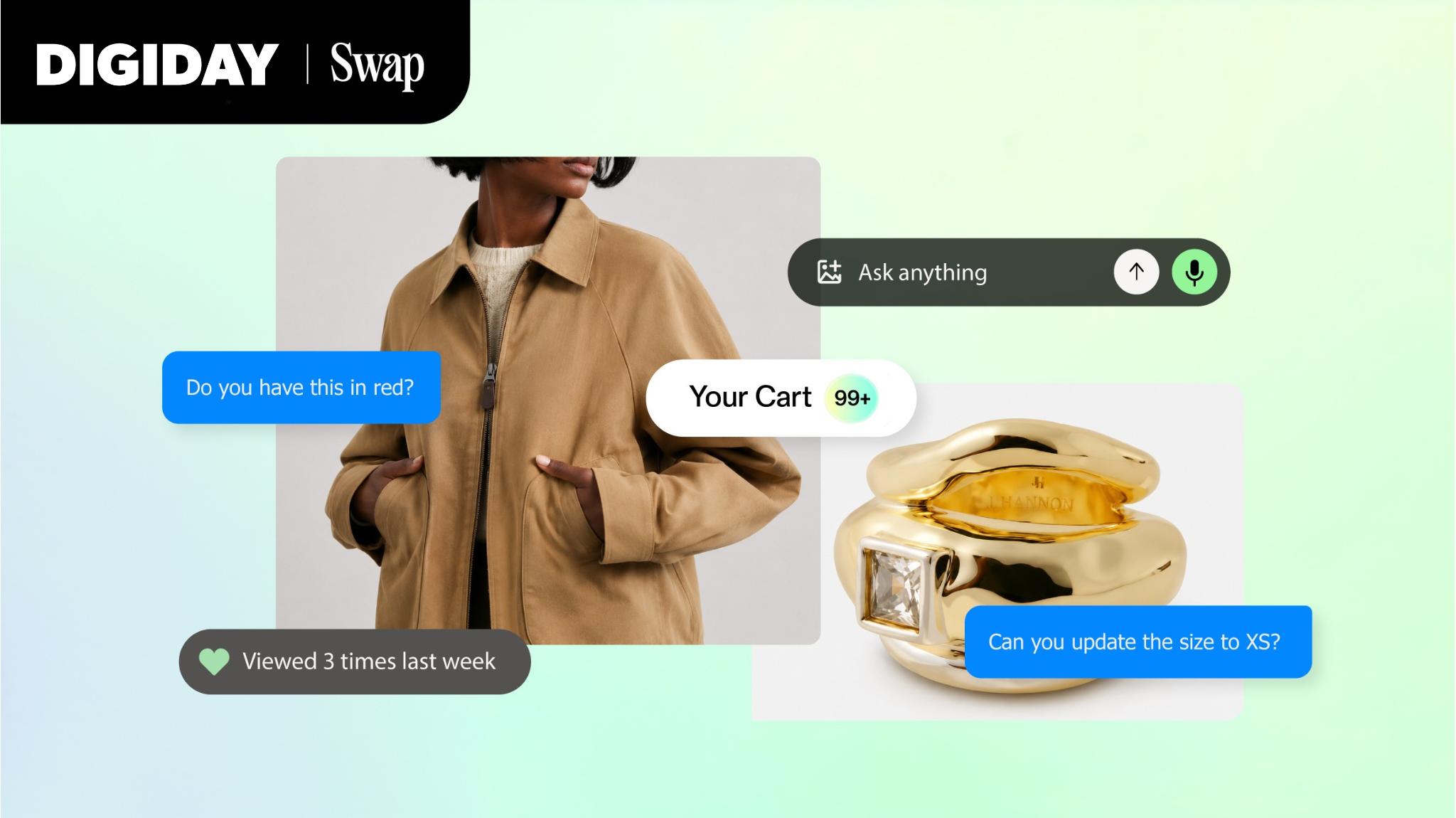
This State of the Industry report, funded by Swap, explores exactly how brands, sellers and firms are embracing agentic business, including agentic stores, to boost purchasing experiences.
Artificial intelligence is the new entry factor in shopping, as even more consumers rely upon AI-powered recaps and assistants to uncover items. Past discovery and item suggestions, AI agents are additionally helping customers evaluate choices, make decisions and even full acquisitions.
According to Salesforce information, AI and representatives drove 20 % of all retail sales and represented $ 262 billion in holiday invest during the 2025 vacation shopping season. To keep up, brands and sellers are implementing agentic devices to much better individualize customer experiences and drive growth. Others are reconsidering the standard ecommerce version from scratch– changing from static internet sites to agentic shops with conversational experiences that lead consumers every action of the way.
For this new State of the Market record, Shiny and Swap evaluated 80 brand name, retailer and firm respondents to discover how they are embracing agentic tools. Ninety percent of respondents are currently using AI to improve their consumers’ buying experience, the survey discovered.
“Lots of people hear ‘agentic business’ and consider the discovery moment: just how does my brand turn up when someone asks an AI what jacket to purchase?” said Juan Pellerano-Rendon, Chief Advertising Officer at Swap. “That’s a real and essential inquiry to surface area in LLMs, but it’s only the entry point.
“What makes our initial agentic store truly transformative is what happens after exploration. An actual agent does not just appear a product and hand the consumer off to a static internet site,” he claimed. “It recognizes context, it asks inquiries, it remembers what you tried to find last time. That connection is what changes the business economics.”
01
Comprehending AI-powered shopping experiences
As AI ends up being much more deeply embedded in day-to-day life, including ecommerce, new (in some cases comparable) terms have arised to explain various capabilities.
- AI representative : A tool that uses a huge language version to search and do activities online.
- Agentic AI : Describes assistants that will certainly be able to act autonomously without follow-up concerns and individual treatment.
- Agentic business : The capability to acquire products or solutions with the aid of an AI agent.
- Agentic storefronts: AI-native, immersive, conversational experiences that direct shoppers from discovery to purchase. Usually on a brand-owned. ai domain.
02
Agentic business tactics and methods
In 2026, brands and merchants are capturing on and adjusting their on the internet presences in feedback to dramatic changes in consumer use AI– accepting the existence and even use of AI agents.
More than half of participants (56 %) are primarily using an interior agentic AI device, while 33 % are mainly dealing with third-party technology companies. Eleven percent are deploying their agentic AI tools via an about even split of interior devices and third-party providers.
Additionally, most of respondents (71 %) report that their shopping websites are established to be visible by AI agents. However, 20 % are unsure if that is the case, while 9 % do not have an AI-discoverable ecommerce site.
According to 2025 Shiny+ Study , more than 1 in 5 brand and firm pros claimed their companies have seen decreases in upper-funnel search traffic (37 %) and lower-funnel search website traffic (21 %) as a result of AI.
“The window to get ahead of this is narrower than many brands recognize,” stated Pellerano-Rendon. “Discoverability in an agentic world isn’t practically search engine optimization any longer. It has to do with whether your item catalog, your brand name context and your consumer data are structured in a way that an AI representative can actually work with.”
Exploration is just one part of agentic business, nevertheless. As AI devices come to be a lot more easily accessible to both consumers and companies, they are coming to be extra ubiquitous across ecommerce websites themselves.
When it involves interesting consumers via agentic AI, greater than 4 in 10 participants are doing so through AI-native/conversational product discovery (46 %), in-chat buying (46 %) and online try-on (41 %). Brands, stores and companies are additionally making use of agentic AI to provide individualized referrals based on user choices (39 %). Much less usual applications include voice-to-checkout (31 %) and hyper-individualized homepages (30 %).
Significant gamers such as Google and Amazon have also presented similar capacities to reach customers. As reported by Glossy , Google presented new shopping attributes throughout 2025, such as price contrasts and virtual try-ons, for its Gemini AI system. In October 2025, Amazon introduced its AI-powered “Assist Me Decide” attribute to offer users referrals on comparable products based upon their shopping background.
“Seventy percent of consumers leave a website without buying, and a substantial section of that abandonment isn’t rate or uncertainty; it’s rubbing,” Pellerano-Rendon stated. “They could not find the piece that matched the event, the fit, the aesthetic. When an agent shuts that void, when it understands you’re seeking something particular for a details moment, conversion complies with.”
Exact and workable information is essential for companies to properly notify their agentic AI devices. Over half are making use of core item features (56 %)– such as item names, descriptions and products– and testimonial signals (54 %)– including rankings and evaluation web content.
Other critical data resources consist of consumer and payment information for checkout (45 %), real-time inventory data (39 %), delivery and return policies (39 %), FAQs (38 %) and current rates and deals (36 %). These point to the full-funnel use of agentic devices, from exploration and consideration via to buy.
In addition, 43 % of respondents utilize existing brand material and interaction standards, such as voice and tone, to inform their agentic AI devices– mentioning how brand names and sellers are focusing on the seamlessness of these devices and looking at them as an expansion of their brand identification.
For example, Gemma, Pandora’s AI sales agent, was created to guide clients through emotionally driven discussions about gifting, relationships and memory. According to Shiny, Gemma tightens its referrals based upon its understandings , recommending pertinent jewelry and describing just how each option connects to the story, matching the assistance of an in-store associate.
Agentic capabilities worsen across the funnel, Pellerano-Rendon clarified, creating a continual experience. Conversational discovery helps customers get oriented, while occasion-based suggestions strengthen factor to consider and functions such as digital try-ons close the void in between rate of interest and self-confidence.
“Each layer improves the last, and the information from one communication makes the next one smarter,” Pellerano-Rendon stated. “Intent data, captured in genuine time, is the most underutilized property in business right now. Conventional shopping produces click data.
“An agentic store creates discussion: what a consumer requested, just how they explained what they desired, what they tried out and denied before they transformed,” he claimed. “That signal is infinitely richer, and a lot of brand names don’t have the infrastructure to record it, let alone act upon it.”
03
The emergence of agentic store fronts
Past on-site chatbots, AI assistants and partnerships with outside AI models, brands and merchants– in addition to their partner agencies– are likewise explore agentic storefronts. In this context, agentic shops are AI-native, immersive, conversational experiences that assist shoppers from discovery to purchase inside the brand name’s very own website.
“A.com and a.ai can coexist and serve meaningfully different experiences to different consumer sectors,” Pellerano-Rendon stated. “As AI comes to be additional ingrained in daily life, the static site– a grid of items, a search bar, a check out circulation– will seem like the mall directory really feels today. Functional, but not what you ‘d select if you had a much better alternative.”
Seventy percent of respondents are currently try out or using an agentic storefront in some form, consisting of 40 % that are actively releasing an agentic store front.
Another 23 % are not currently testing or utilizing an agentic storefront, however strategy to within the following 12 months. Only 7 % do not have existing plans in this field.
Amongst those with substantial financial investments in agentic commerce devices and/or agentic shops, 62 % called improved brand discovery as one of their leading objectives. Once again, this mirrors the influence and relevance of shoppers’ altering discovery routines, far from search and social media towards AI search and assistants.
A minimum of fifty percent of these participants are also prioritizing boosted conversions (57 %), enhanced UX/personalization (56 %) and lowered client procurement expenses (50 %). And while 43 % are buying agentic commerce and agentic shops with the objective of creating a totally new earnings network, their various other priorities are sure to influence the lower line– whether in the short term (lowered consumer returns, 49 %) or long term (enhanced customer loyalty, 47 %).
As brand names and retailers end up being a lot more fluent in agentic stores, however, they do expect some obstacles. Principal among them are data needs (57 %) and gauging agentic storefront ROI (57 %).
Dimension around agentic business has been mentioned as a difficulty by major brand names. As an example, Modern Retail reported that Fabletics lacks a feeling of how many sales come from AI engines, though the activewear brand has allowed check out within Perplexity and gets traffic from ChatGPT.
In the case of agentic store fronts running on.ai domain names, nonetheless, Pellerano-Rendon encouraged that they may be extra measurable than many brand names expect. When these agentic storefronts run together with a traditional ecommerce site, brands can directly contrast metrics such as conversion rates, typical order worth, return rates and time on site in between the two experiences.
Expense is an additional considerable worry (46 %) amongst respondents utilizing agentic commerce. And while more than half of participants (53 %) are concerned about low consumer rate of interest or count on agentic storefronts, brand name safety (35 %) and diminished brand name identification (35 %) are viewed as less substantial difficulties.
“The information we’re currently seeing– 2 x conversion prices, 3 x time on site, 20 % decrease in returns– informs us customers do favor the better alternative when they have access to it,” Pellerano-Rendon said. “The question for brands isn’t whether to make the shift. It’s whether to make it early enough to matter.”
04
Expense, data transfer are main barriers to agentic commerce fostering
Although only a minority of respondents are not utilizing agentic business and/or store fronts, amongst this friend, cost and transmission capacity are the primary obstacles to fostering.
While information requirements are anticipated to be a leading difficulty amongst adopters of agentic tools, just 8 % of non-adopters pointed out inadequate data or information quality as the factor for keeping back their investment.
“One of the most typical concerns we listen to is that brands do not recognize if their data prepares. The honest response is, it does not need to be ideal to start,” Pellerano-Rendon stated. “What matters is that you own it. That possession is the foundation on which whatever else is constructed.”
Unsurprisingly, 42 % of this mate said they would require lower prices to take on agentic AI commerce and/or store fronts. Similarly, 53 % of present users claimed reduced expenses would certainly increase their investment in the innovation. Adopters and non-adopters alike likewise stated technology renovations and more technical training would likely stimulate enhanced investment.
“What I would claim to brand names in the resistance or wait-and-see camp: the signal from shoppers is already uncommonly solid for something this early,” stated Pellerano-Rendon. “Consumer interaction with agentic store fronts is moving much faster than brand name fostering. That void doesn’t generally enclose the brand name’s favor. The classification has early moving companies and every person else, and the early moving companies are constructing a data and experience benefit that will be extremely challenging to close later.”
05
The future of agentic stores
No matter whether they are currently utilizing agentic business and agentic shops, the majority of participants (88 % of present adopters and 58 % of non-adopters) forecast their financial investment in this innovation will certainly raise over the following 12 months. This consists of 25 % of current adopters who expect to significantly increase their investment in agentic business and storefronts.
Ultimately, participants’ bullish attitudes toward agentic business reflect market changes that are already underway. Bain & Co. projects the agentic AI market could reach $ 300 to $ 500 billion by 2030 , while McKinsey estimates that AI agents might generate as high as $ 1 trillion in U.S. retail earnings by the very same year
Also as forecasts vary, the moment for the elegance and garment industry to prepare is now– according to Nielsen, 49 % of customers already receive charm recommendations from generative AI as they seek extra tailored buying experiences.
2026 is the year this goes from very early adopter area to an acknowledged critical concern,” Pellerano-Rendon stated. “You’ll start to see brand names that released agentic stores in the last 12 months publishing outcomes that are difficult to argue with, and that will certainly pull the remainder of the market forward.”
The brand names, retailers and companies focused on agentic business currently are ahead of the competitors in regards to innovation in addition to data, Pellerano-Rendon explained. Representatives learn via every client conversation, try-on and occasion-specific demand– constantly creating exclusive interaction data that makes the experience much more accurate.
“The brand names obtaining the strongest outcomes are the ones treating this as an item connection, not a supplier connection, iterating regularly, sharing responses and letting the representative gain from actual client actions,” Pellerano-Rendon added. “Our technique is constantly to integrate in close collaboration with the brand name. Every customer we collaborate with has a various catalog, a different client, a different set of restrictions. The representative needs to reflect that.”
For stakeholders starting with agentic commerce and agentic storefronts, he advised believing beyond the restrictions of a standard fixed website to consider shopping experiences that will offer customers better.
“Commerce is moving much faster than it has at any type of factor in the last two decades. The fixed website had a remarkably long run,” Pellerano-Rendon stated. “What replaces it will be formed by the brand names going to move before the mainstream catches up. The chance isn’t just to adopt a new channel. It’s to define what modern-day business appears like for your group before somebody else does.”
Established in 2022 by Sam Atkinson and Zach Bailet, Swap constructed the first agentic storefront, changing typical static websites with immersive, agent-led commerce experiences that take buyers from product exploration to virtual try-on to checkout in a single branded flow. Relied on by 800 + brands, Swap also gives best-in-class facilities from cross-border, returns and inventory to tax obligation and worldwide compliance, assisting sellers market anywhere and scale internationally on one merged system. To learn more, check out Swap Commerce.
Recommended Social & Advertisement Technology Equipment
Disclosure: We might gain a commission from affiliate web links.
Leave a Reply